
Short answer: Choose Plaud if you want the more polished app, stronger audio quality, and easier personal automations. Choose Pocket AI if unlimited free transcription, USB-C charging, longer battery life, and two-way MCP actions matter more.
Both devices can record in-person meetings, online calls, and phone conversations, then turn them into transcripts, summaries, and notes. We compared their hardware, software, integrations, and current pricing so you can pick the right AI recorder without second-guessing the purchase.
If meeting follow-through is the bigger problem, our guide to meeting productivity tools for remote teams covers the rest of the workflow.
Pricing and features were checked in September 2026 and can change.
Plaud vs. Pocket AI: Quick Verdict
| Features | Plaud | Pocket AI |
|---|---|---|
| Recording | In-person, online meetings, and phone calls | In-person, online meetings, and phone calls |
| AI Transcription | Yes | Yes |
| AI Summaries | Yes | Yes |
| Speaker Identification | Yes | Yes |
| MCP Integration | One-way MCP integration | Two-way MCP integration |
| Battery Life | Up to 30 hours | Up to 4 days |
| Storage | 64GB | 64GB |
| Price | $159 | $129 |
| Best Choice For | Better user experience | Convenience |
What Is Plaud, and How Does It Work?
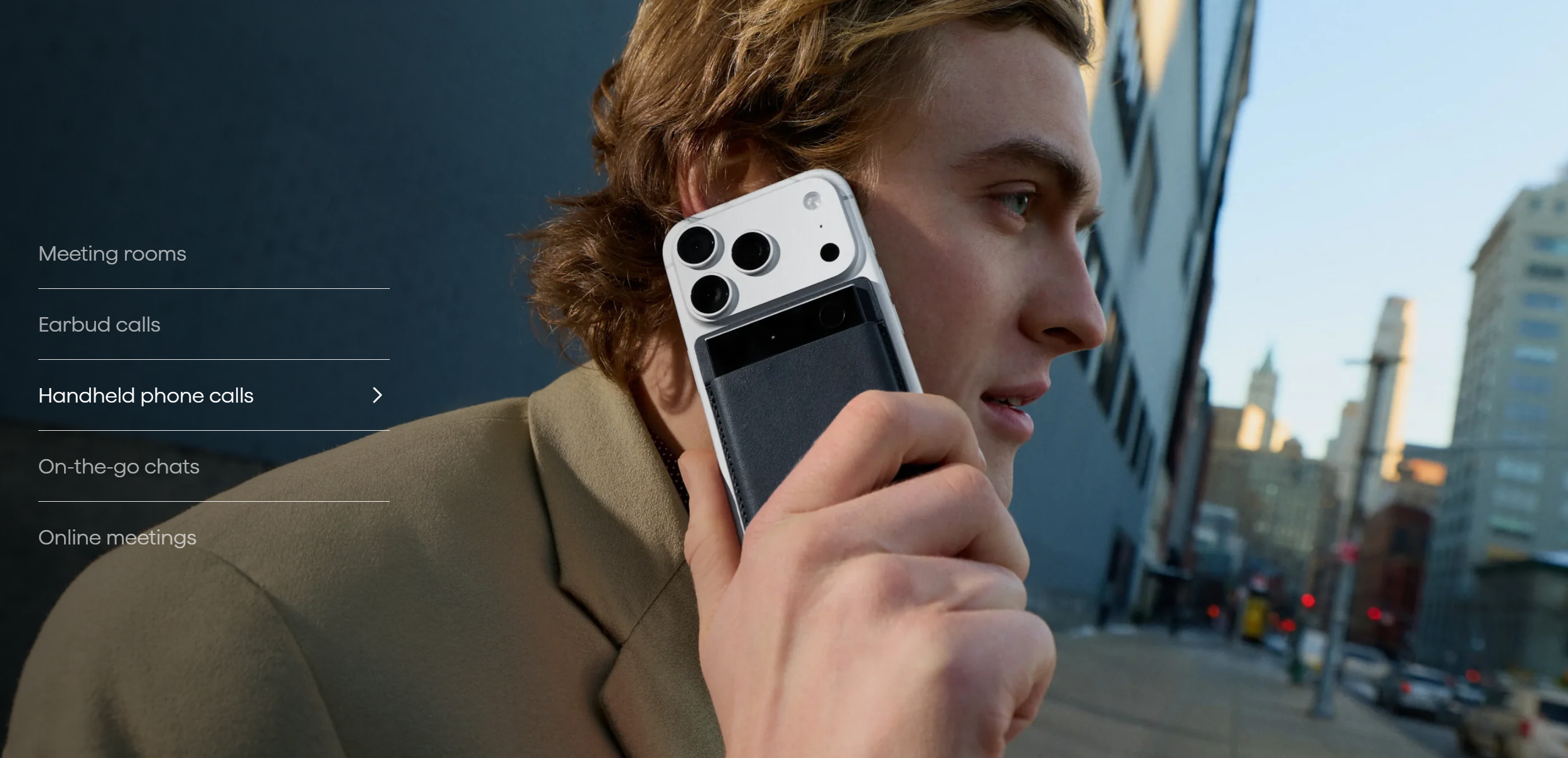
Plaud is an AI-powered note-taker that comes with a card-sized recording device.
You attach the device to your smartphone or place it on the table to record conversations, and its AI converts them into transcripts, summaries, and notes.
You can use Plaud to record any audio conversation, including in-person staff meetings, Zoom conferences, and client calls. All you need to do is turn it on and set it on the table or attach it to your phone.
Once the recording is complete, Plaud transfers the file to its cloud app, where you can generate transcriptions and export them as MP3, PDF, DOC, and TXT.
If you want, you can also automate the entire workflow, so you don’t have to do anything manually. Plaud can automatically transcribe and email you the summary. Pretty handy, right?
Here’s what Plaud offers;
Core Features
- Card-sized recorder and clip-on pin recorder.
- Audio recording.
- Transcription, speaker identification, and timestamps.
- AI summary, mind maps, and notes.
- Templates.
- Auto-workflow.
- AI search.
- Home screen widget.
- Export and sharing.
- Integrations.
- Desktop, web, and mobile app.
What Is Pocket AI, and How Does It Work?
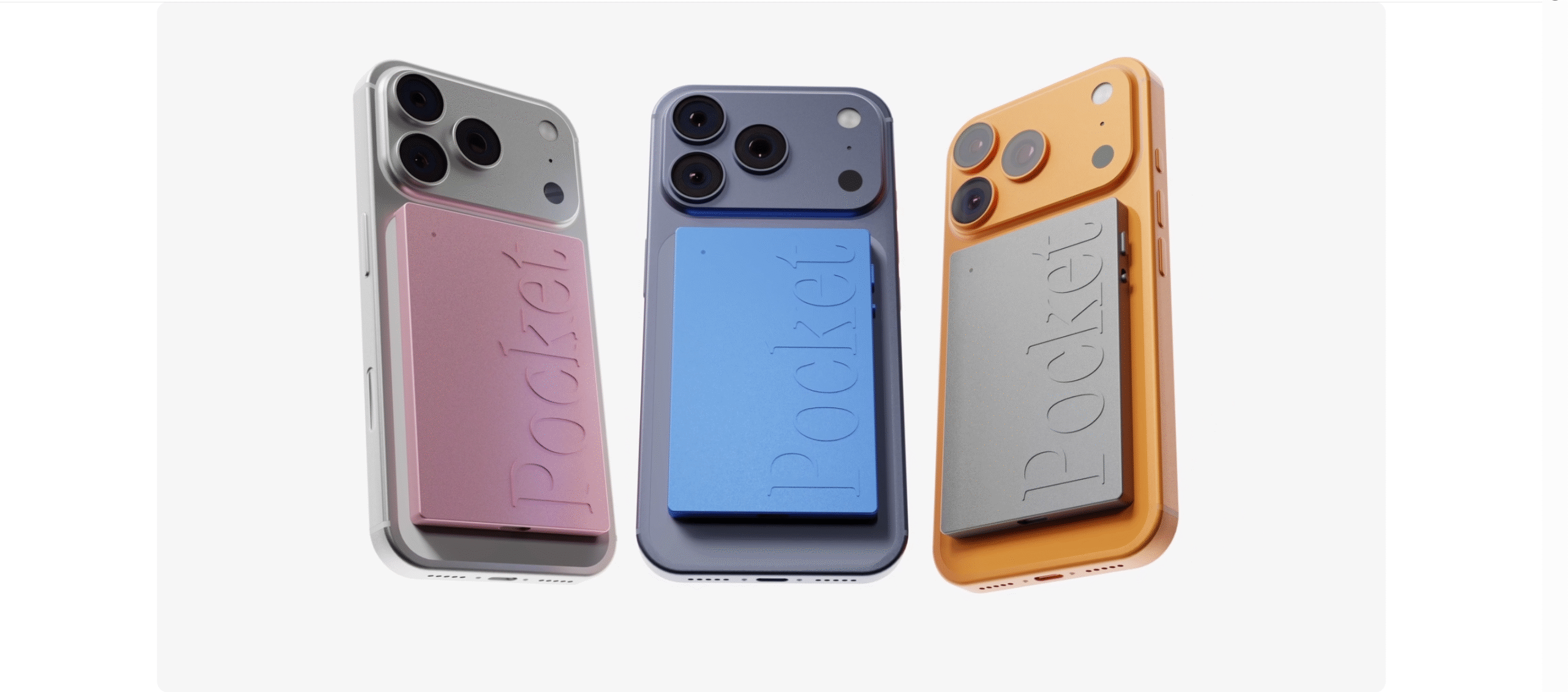
Pocket AI works just like Plaud.
It comes with a card-sized device that records conversations and converts them into transcripts, notes, and mind maps.
You can record any meeting, whether you are online or offline. The audio is saved locally on the device, and once you connect to the app, it’s uploaded to the cloud.
Exporting is straightforward here, and you can share files as links too. The options aren’t as versatile as Plaud’s, but they get the job done.
You can also integrate Pocket directly with your everyday tools, like Calendar, Google Tasks, Google Drive, and ChatGPT. This helps you export notes to other apps and create custom automation.
Here’s what Pocket offers.
Core Features
- Card-sized recorder.
- Audio recording, transcription, speaker identification.
- AI summary, mind maps, timestamps, and notes.
- Templates.
- Custom workflows.
- AI search.
- Home screen widget.
- Export and sharing.
- Integrations.
- Desktop, web, and mobile app.
Plaud vs. Pocket AI: Feature-by-Feature Comparison
Plaud and Pocket have a lot in common, but once you get into the details, you’ll notice subtle differences.
I’ve split the review into hardware and software to keep it simple. The software is where most of the differences lie, but their recorders also offer different user experiences.
Let’s start with the hardware capabilities first.
1. Hardware and Recording Quality
Plaud and Pocket both come in card-sized recorders, but there are some differences in their specs.
Here’s a summary of their hardware features
Plaud Hardware
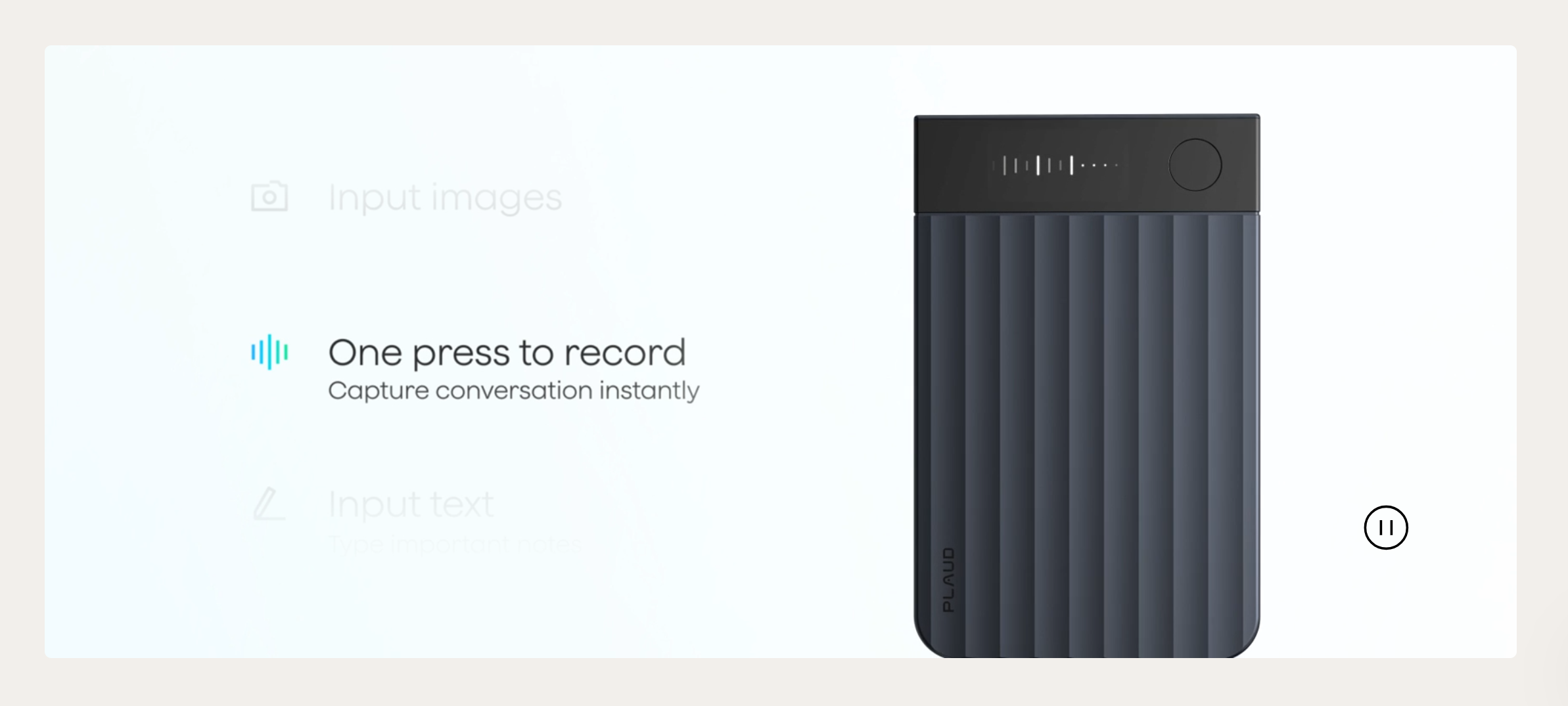
Plaud offers several hardware options, but its Note and Note Pro are the most popular.
The original Note is a small, portable recorder with a magnetic case, so you can attach it to the back of your phone for call recording.
The device has a single button for voice capture and another to switch between in-person and call recording.
The newer Note Pro doesn’t have a physical button; instead, it has something better—smart switching that automatically detects and switches modes.
It also has a small screen that shows the recording status.
It’s an excellent feature because you never have to wonder whether your device is recording or has accidentally turned off.
The recorder does light up like a tiny beacon, though. So, if you don’t like to draw attention, you’ll probably hate this feature.
The normal range for the original Note is around 2 to 3 meters, and you can record for 30 hours straight. If you purchase Note Pro, you’ll get more battery life and range.
The only drawback of the Note is its charging design. Whether you buy the original or latest device, you’ll have to use its magnetic cable to charge it.
It isn’t a deal breaker, but it’s a hassle.
Apart from the card recorders, Plaud offers a pin-sized device you can attach to your jacket or neck strap for in-person meetings.
Its battery life is a little lower, but the storage capacity is the same.
One more thing. Plaud has recently introduced AI earbuds for call recording. They’re currently in limited quantities, but once they become mainstream, they could be a game changer. Let’s see how they turn out.
Pocket AI Hardware
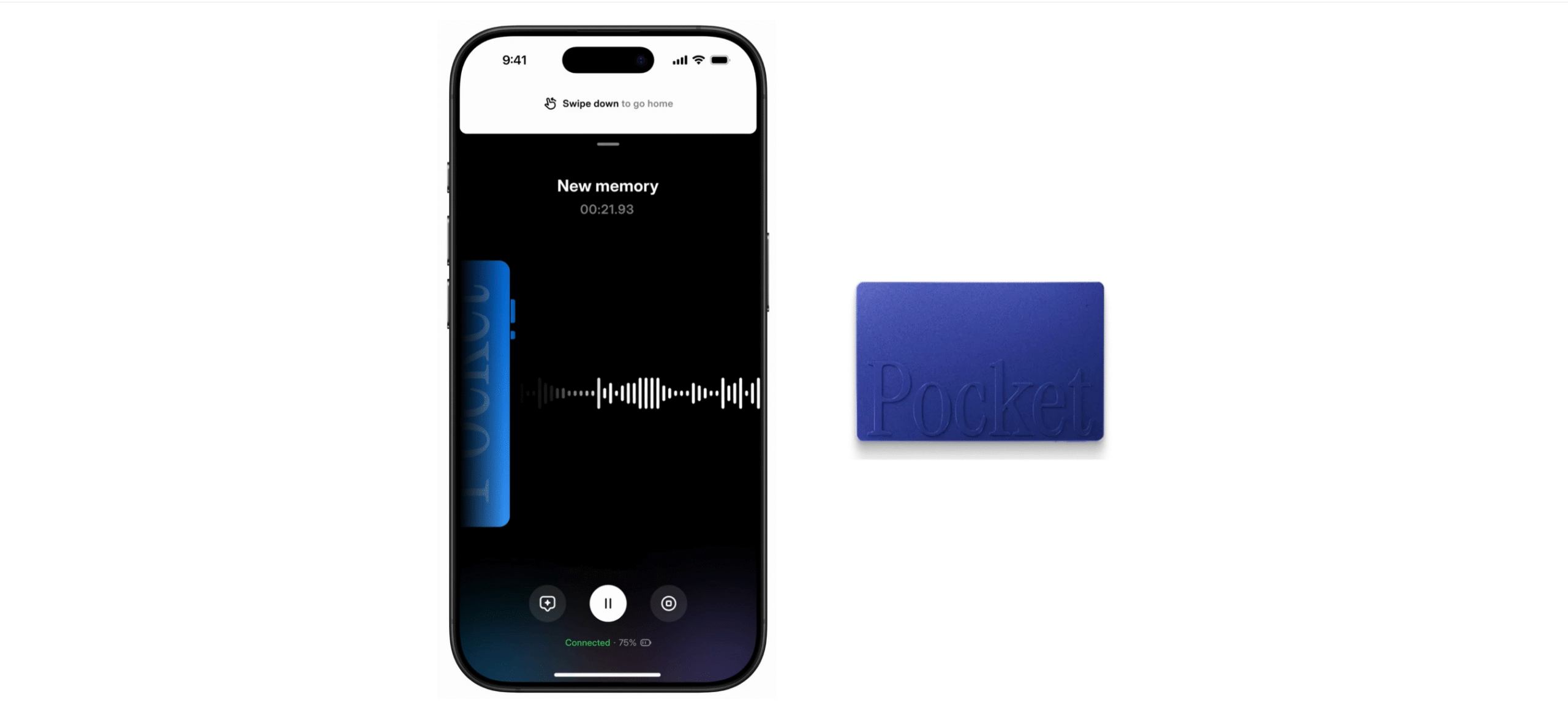
Pocket is a new company, so it currently sells only card-sized recorders.
It’s simple, has a 15-meter range, 64GB of storage, and 4 days of active battery use.
It also has built-in MagSafe, so you don’t need to carry an extra case or ring to stick it to the back of your phone.
If your phone doesn’t support MagSafe, however, Pocket provides an adhesive mount for that. So I wouldn’t worry much about it.
Design-wise, Pocket is a bit clunky, to be honest. Its buttons are on the side instead of the front, and operating them is annoying. It’s a minor inconvenience, but something to consider.
One thing I like about Pocket is its charging. It uses a standard USB-C cable, so you can just use your phone charger. No need to carry a separate cable.
Verdict
Plaud’s hardware is comparatively better. It’s well-thought-out and comes in different designs. It also has excellent audio quality.
But the charger is an extra weight you don’t want to carry around.
Pocket, from that perspective, is simple. The device itself is a little less intuitive, but charging is easy. It also has a good range.
Based on audio quality, I would give Plaud points. Pocket might have an edge in range, but Plaud wins on audio quality.
My suggestion? If audio quality is your priority, go for Plaud. If it’s convenience, choose Pocket.
2. Apps, Transcription, and AI Features
For a wider look at automation beyond note-taking, see our roundup of the best AI time-management tools.
Now that we have a general idea of Plaud and Pocket’s hardware, let’s compare their cloud apps.
Plaud Software
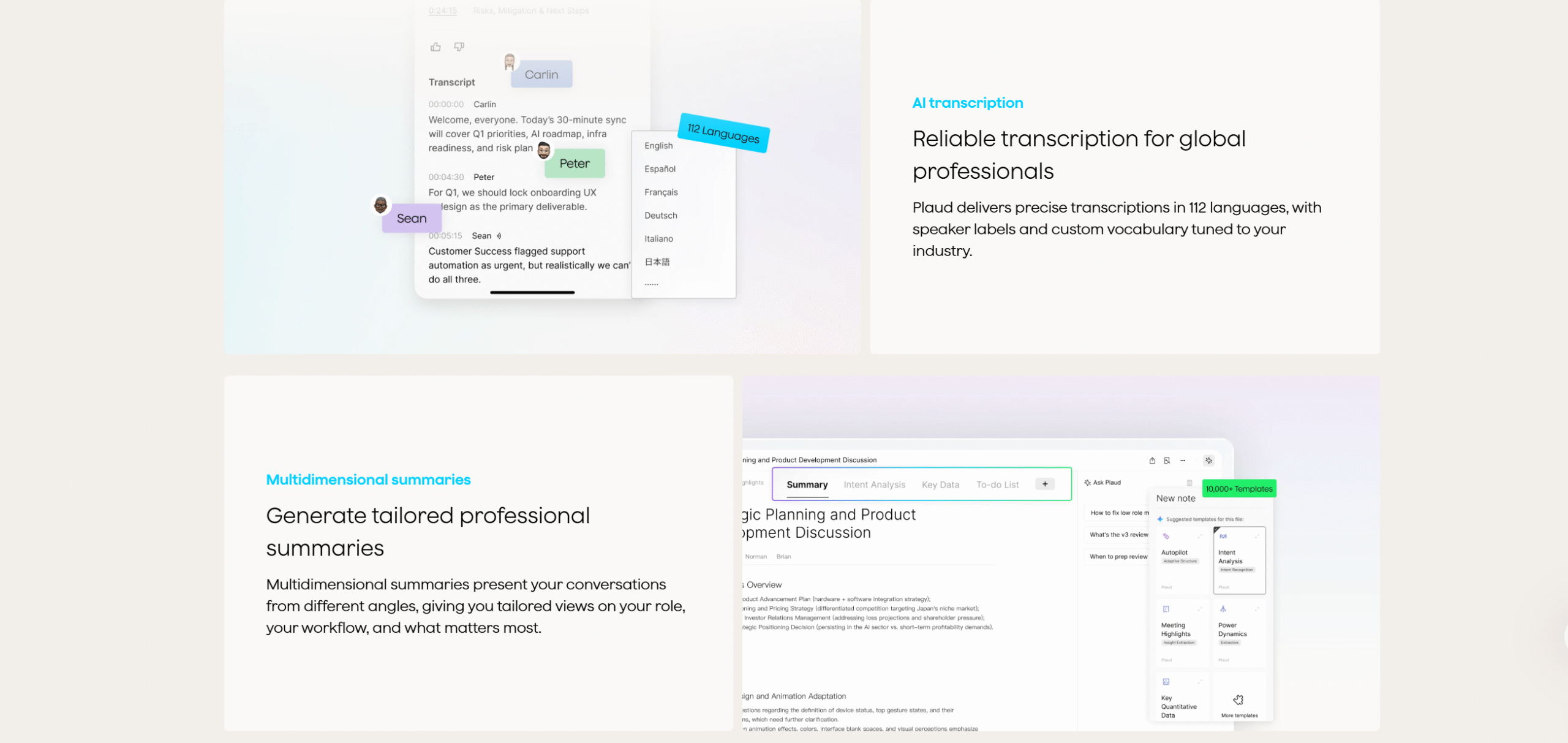
Plaud is easy to navigate and feels more polished. It also has several AI tools.
You can convert your recordings into different languages, label each speaker, and turn transcripts into notes. Plaud provides over 10k summary templates for different use cases, but you can create custom templates too.
If you use specific industry terms, you can add them to the custom settings. Plaud automatically picks them up and uses them in future transcripts.
A mind map is also included to help you visually connect your notes. It’s a side feature, like analytics, but it’s a nice addition.
One of Plaud’s core features is auto-flow.
You can create a recording workflow, like summarizing and saving, and set it on autopilot. Plaud works well with third-party tools like ChatGPT, Calendar, and Zapier, giving you more ways to automate your workflow.
Another feature you’ll like is its AI Ask. It lets you find files and ask questions in natural language.
These two core features aren’t perfect, but they can save a lot of your time.
Pocket AI Software
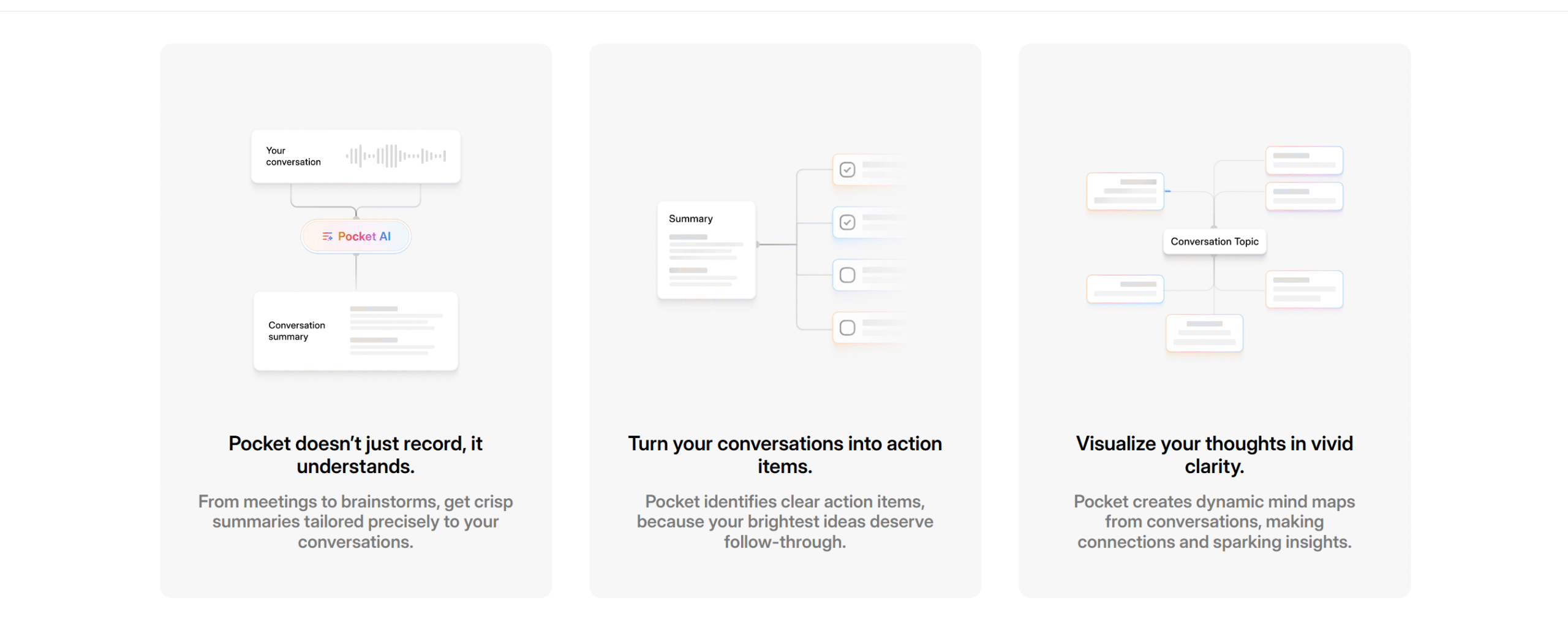
Pocket has everything Plaud offers.
You can automatically send recordings to the cloud app and transcribe them in multiple languages.
The transcription comes with timestamps and speaker labels, but you can also train Pocket to recognize voices and label speakers automatically in future recordings.
If you want AI summaries and actionable notes, the app can do that too. Its template library isn’t as vast as Plaud’s, but you can build custom templates.
Apart from the core functions, Pocket provides AI search and mind maps. You can visualize your notes with mind maps, tag recordings for easy search, and use AI to find specific information in your transcriptions.
What sets Pocket and Plaud apart is how they handle integrations.
Plaud provides ready-made automations, while Pocket AI offers webhooks for custom triggers on its Enterprise plan. Plaud is easier for individuals; Pocket AI gives technical teams more flexibility.
Pocket also offers two-way integration with AI tools like ChatGPT.
Meaning the AI can retrieve information and send changes back. Plaud currently has only one-way integration.
Verdict
Pocket is really impressive for a new product, but it hasn’t reached Plaud level yet.
The transcription and summaries work well, but Plaud delivers better results.
Pocket’s automation is also limited to the enterprise plan, and it feels more developer-focused. Plaud’s auto-flow is designed for individuals and is easily accessible.
Personally, I don’t think there is a huge gap in their main features, but Plaud’s app, overall, is more polished.
3. Pricing and Ongoing Cost
Plaud and Pocket both follow a freemium model.
They give you access to the basic features for free and charge a premium subscription for advanced features.
For recording devices, you’d have to pay separately. I have included the prices in the summary.
Here’s the summary of their prices.
Plaud Pricing
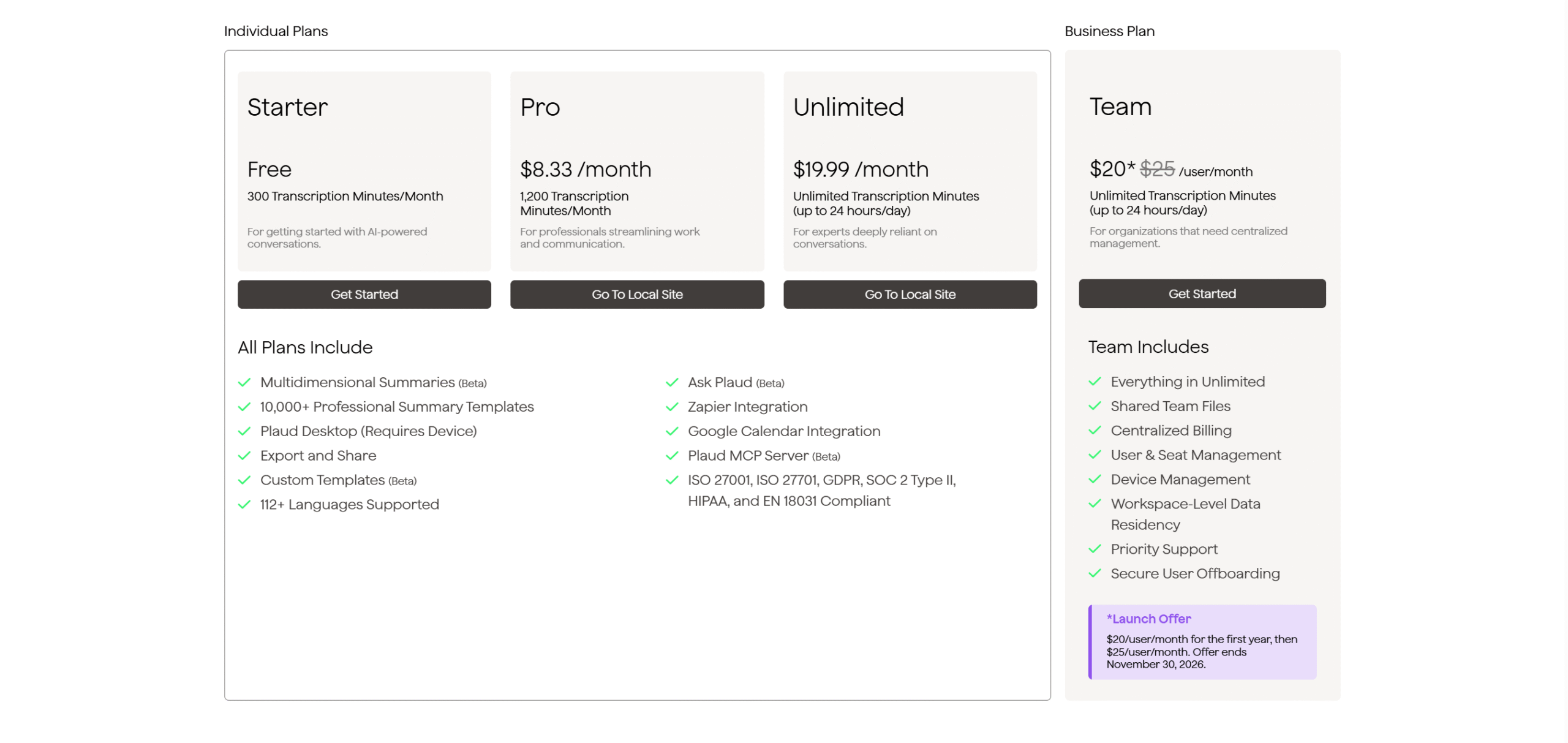
Plaud has four core packages.
Starter: It’s a free plan. You can access all the AI features, but you can transcribe only 300 minutes per month.
Pro: It costs around $18 per month and increases the limit to 1,200 transcription minutes.
[The available minutes don’t carry forward, by the way. Plaud resets the minutes each month.]
Unlimited: It costs $30 per month with unlimited minutes. You can record all day and get unlimited transcriptions.
Team: It costs $35 per month and includes collaboration features such as a team workspace and file sharing.
Hardware: Plaud currently sells two types of hardware. Card-sized recorder and clip-on pin. Both cost $159 each.
Pocket AI Pricing
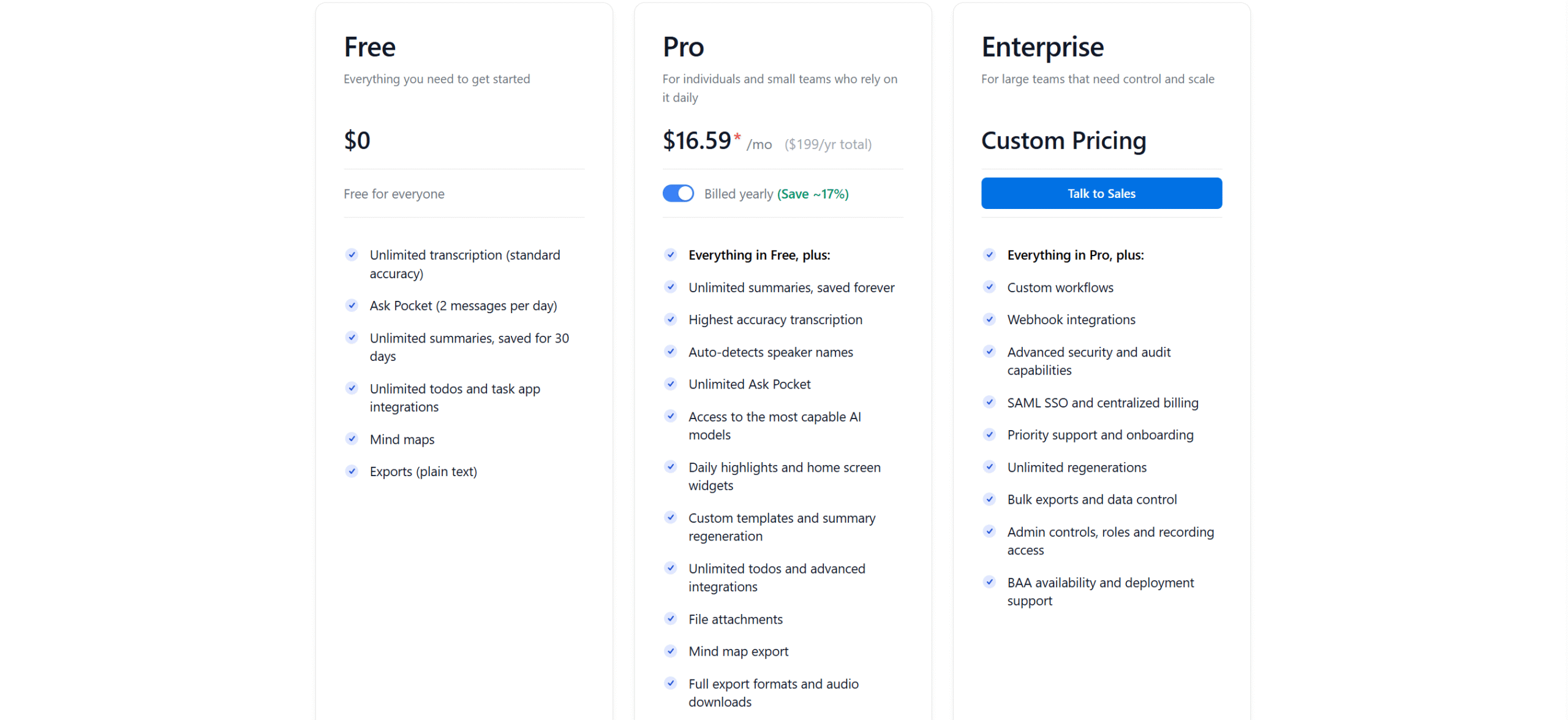
Pocket has three core packages.
Free: You get unlimited transcriptions and summaries, but only basic AI functions.
Pro: It costs $20 per month and includes advanced AI features like speaker identification and full export formats.
Enterprise: It’s a tailored package and contains custom workflows and admin controls.
Hardware: Pocket’s recorder costs $129. Group packages are also available.
Verdict
Plaud and Pocket have built their subscriptions a little differently.
Plaud gives you access to the AI features, but there is a transcription limit on each plan.
Pocket takes a completely different approach. It gives you unlimited free minutes and charges only for advanced AI functions.
If you want to use the recorder for transcription and summaries only, Pocket is an obvious choice.
You don’t even have to buy the premium subscription for it. You can enjoy unlimited transcription on the free plan.
Plaud vs. Pocket AI: Pros and Cons
On the surface, both Plaud and Pocket appear similar, but each has an edge in certain areas that might influence your purchase decision.
Here are a few pros and cons to consider before purchasing either of the two.
Plaud
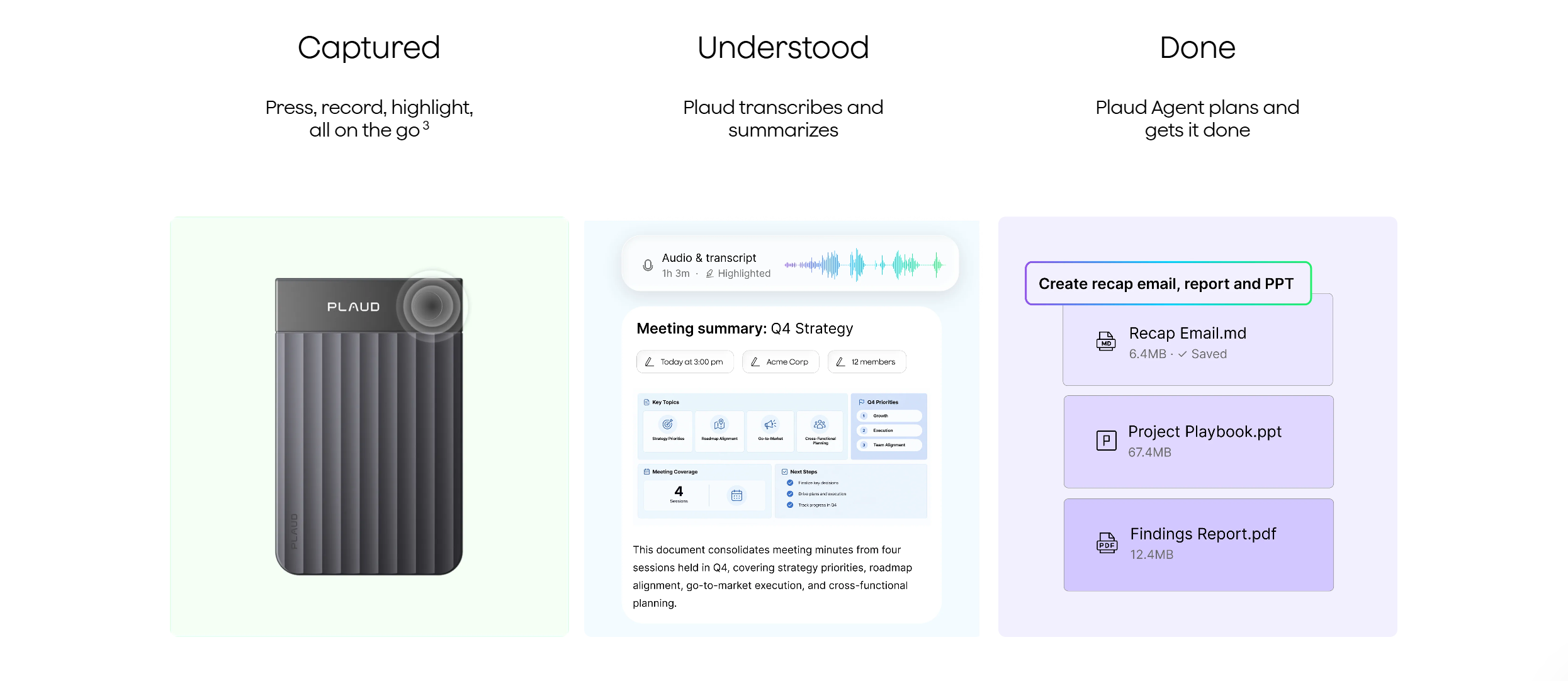
Pros
- The recorder’s audio quality is better comparatively.
- The app is more mature, and the user experience is superb.
Cons
- The free plan is extremely restricted. You can only record 300 minutes per month.
- Plaud offers an MCP server in beta, but Pocket AI documents two-way actions that can write changes back to Pocket.
Pocket AI
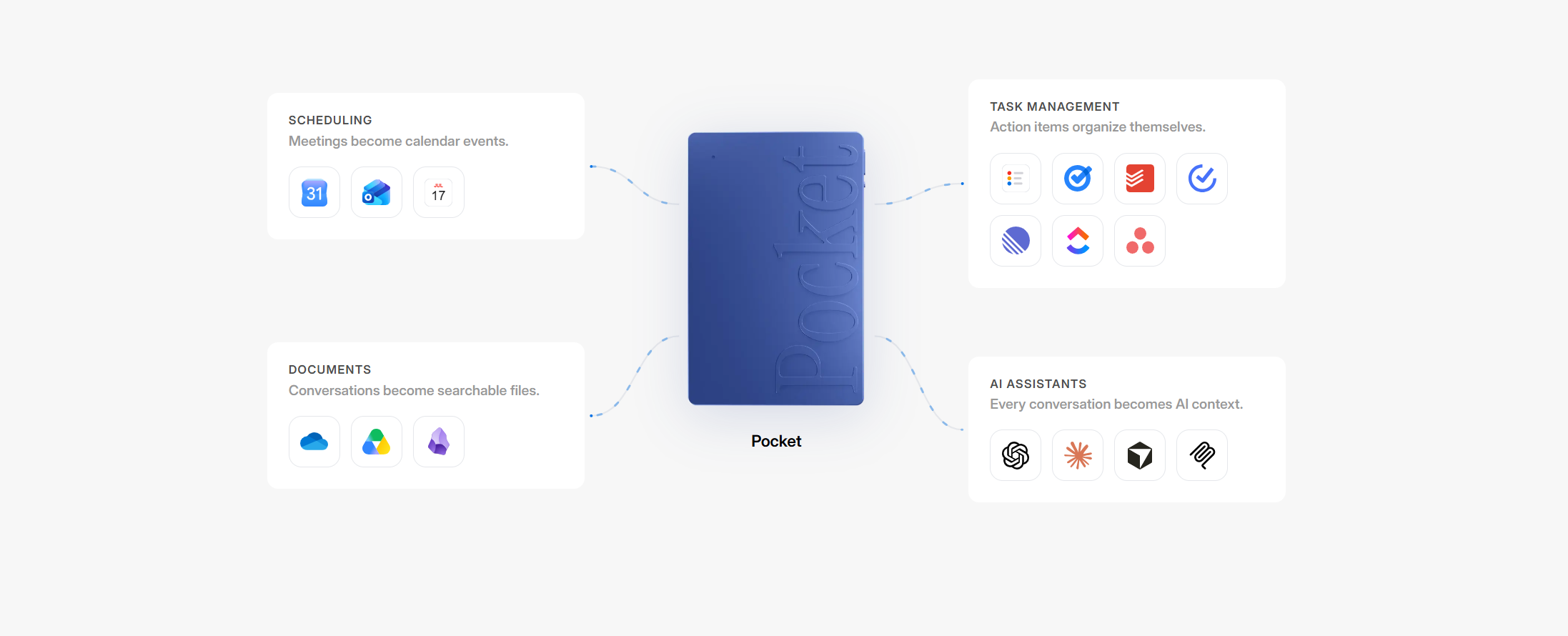
Pros
- You get unlimited minutes in the free plan, and the community is highly active. It also offers more features and two-way integration with external AI tools.
- It’s easier to charge, has a built-in magnet for the phone, and the battery lasts longer.
Cons
- All the good stuff is locked behind the paywall.
- Audio quality is good but not exceptional.
Final Verdict: Plaud or Pocket AI?
Plaud is the better all-round choice for buyers who care most about audio quality, a mature app, and easy automation. Its hardware and software feel more refined, but the free plan is limited to 300 transcription minutes per month.
Pocket AI is the better value choice for heavy recording. It offers unlimited standard transcription on the free plan, longer battery life, USB-C charging, and more flexible two-way MCP actions. The trade-off is a less polished experience and advanced features that require Pro.
Choose Plaud for polish and recording quality. Choose Pocket AI for unlimited transcription and convenience.
If most of your calls happen online, compare the best video meeting apps before buying dedicated hardware.
Frequently Asked Questions
Is Pocket AI better than Plaud?
Pocket AI is better for users who want unlimited free transcription, long battery life, and USB-C charging. Plaud is better for users who prioritize audio quality, app polish, and ready-made automations.
Does Pocket AI require a subscription?
No. Pocket AI includes unlimited standard transcription and core features on its free plan. Pro is required for higher-accuracy transcription, automatic speaker names, unlimited AI chat, custom templates, and advanced exports.
Does Plaud require a subscription?
No, but Plaud’s free Starter plan is limited to 300 transcription minutes per month. Paid plans increase or remove that limit.
Which recorder is better for phone calls?
Plaud is the stronger choice when recording quality and a refined workflow matter most. Pocket AI is compelling if battery life, charging convenience, and free transcription are higher priorities.


 A better way to manage projects and clients for freelancers
 Get through busy days like a breeze with Reclaim.ai