Remember the last time you walked into your local bank?
No doubt, your friendly neighborhood banks are safe and time-tested.
After all, they are largely accredited by regulatory authorities like the Federal Reserve System or FDIC.
However, problems like long waiting hours, fixed support hours, and prolonged transaction times plague individuals and businesses alike.
They pose even greater problems for startups. Because the cash flow process for new businesses is time-critical.
While having a limited amount of cash buffer, companies don’t want money to stay in transit for a long time.
Or else, new founders would fail to run their businesses smoothly. Even worse, pay hefty late fees.
While the disruption of the pandemic-hit banks and reduced P2P interaction is still afresh.
That was certainly a wake-up call for the fintech sector. Leading to the growth of neo-banks. And foster massive adoption of online banking, e-wallets, and contactless payments.
So what the heck is a neo-bank and why should startups care?
Needless to say, it’s an online-only bank.
In this article, I’m going to discuss the 12 best online banks for startups that are mostly talked about.
Neo-bank closely resembles a traditional bank. But without physical branches.
However, they’re not issued a complete banking license. Instead, they’re affiliated or tied to traditional banks.
Equally safe and insured. But with faster services. And better customer experience.
Yes, you can withdraw money and make deposits. Get debit and credit cards.
And everything from shopping, accounting, and invoicing to bill and tax payments.
Right from a mobile app. While bringing finance at your fingertips.
And what are the benefits of online banks?
- Hassle-free online process of opening a bank account without being finance-savvy.
- Quick onboarding process and time-saving customer support.
- Mobile and web apps provide a bug-free interface and better user experience.
- Mobile app provides a robust set of features including banking, money transfer, virtual cards, investment options, and many more.
- Helps you categorize, track, and analyze everyday transactions from business, family, and shopping to investments.
- While they come with business checking accounts, some banks also provide savings accounts.
- Decent Annual Percentage Yield (APY) interest rates along with cashbacks, community, and additional rewards.
- Lets you set your financial goals by automating the money transfer from your business to your savings account.
- No fee for opening the account, a lower banking fee, and no minimum amount required in most banks.
- Ability to link and keep accountability of your existing traditional bank accounts with your neo-bank account.
With that being said, there is no surprise that the Neo banking market value is expected to grow at a CAGR of 54.8% by 2030. While the market size in 2022 was over $66 billion.
1. Mercury

Started a business but struggling to raise funds?
Although Neobanks simplifies many banking processes for startups. Only a few of them offer a growth platform where you can network with the right investors.
With Mercury, you don’t have to worry about where you are in your startup journey. Pre-seed, seed, series A, or IPO.
You’re going to find a diverse community of active investors and VC funds – no matter the phase of your startup.
Mercury is also known to offer a $0 banking stack.
That means no monthly fee. No deposit for a new account. No minimum balance. No overdraft fee. And no charges on USD wires for domestic and international transactions.
However, for any non-USD currency exchange, Mercury charges you a 1% fee.
Mercury Bank Key Features
- Mercury only costs you:
while making mass transactions on its API,
on Treasury feature,
and non-USD money exchange.
- You can issue Mercury’s IO credit card and earn 1.5% cashback on any purchases. However, it requires a minimum deposit of $25,000.
- Mercury Treasury lets you earn high-yield APY. However, the minimum account balance required is $500k which provides a net yield of 5.31% APY. The rate further goes up to 5.51% in case your balance is over $20M.
- Mercury Raise is an all-in-one founder success platform to help you raise funds. You can find active investors and pitch them. You can even network with new founders over Slack and get community support throughout your fundraising journey.
- The advanced payroll feature helps you maintain dedicated accounts for your team. You can get your payroll provider to securely pay your team. As well as set a target range.
- You can invite many team members. And even set access and permission levels. For example, admin, bookkeeper, and custom access.
Mercury Bank Pros and cons
Pros:
- $0 banking stack features
- Mercury app on both Android and iOS for quick account views and edits
- Domestic and international wire transfers at no cost.
- Advanced payroll and team features
Cons:
- Unavailable for solo trusts and proprietorships
- Lack of interest earnings
2. NOVO

Online sellers often get themselves jumbled while keeping up with finances. Unless you have a business checking account, invoice tracking, budget tools, savings – all in one place.
Novo is exactly the platform that brings you the convenience of receiving and maintaining funds.
It is relatively a new fintech company backed by Middlesex Federal Savings. Known to provide a safe space for small merchants. And make business banking easier than traditional banks.
Unfortunately, you won’t get interest earnings here.
But with a $0 monthly fee and a minimum one-time $50 deposit, Novo seems like a real deal.
Novo Bank key features
- There is no monthly fee or transfer fee. Also no charge for the standard ACH transfers.
- Novo Boost is the latest feature that helps startups receive faster payouts – as much as over 90% faster on Stripe. And it’s absolutely free.
- Novo Reserves is another interesting tool that lets you set aside your budget for specific uses. Such as payroll, taxes, rents, and many financial liabilities. Which makes it easier to track the expenses and reserves for each use case.
- Integrated invoicing feature that helps you create and send invoices right from the business checking account.
- Easy to integrate with Quickbooks, Xero, Shopify, Square, Apple Pay, and Google Pay. And even other neo-banks like Wise.
- Although there is no credit card, Novo does offer virtual cards specifically to LLCs. However, individual users can get a debit Mastercard at no cost.
Novo Bank Pros and cons
Pros:
- $0 monthly fee with a minimum opening deposit
- No fee for international transactions
- ATM fees are refunded
- Integrates with the best payment gateway, e-commerce, and bookkeeping tools.
Cons:
- Doesn’t have interest earnings
- Novo virtual cards are limited to only LLCs
3. Lili bank

Keeping track of finances may sound overwhelming to newbies.
But when startups scale, they look for more robust banking solutions to manage complex cash flow.
Therefore, with tiered plans, Lili makes sure businesses of all levels equally leverage the benefits.
So as per the size and banking needs of your business, you may choose from 3 different plans.
And yes, they offer a free basic plan as well.
Lili Bank is a part of Choice Financial Group which provides all-in-one banking solutions. From business banking, invoicing, accounting, and bookkeeping to tax preparation, Lili has got you covered.
Lili Bank key features
- On each plan, you receive a debit card and access to the MoneyPass network ATM. Without any fee.
- The free Basic plan comes with up to 6 monthly checks and up to $6000 monthly deposits. Whereas the Pro plan users can go up to $50k deposits per month.
- Attractive interest earnings of 4.15% on savings on all the paid plans.
- Lili Smart and Premium plans offer a Smart Bookkeeping feature. A handy tool to keep accountability of income, expenses, and taxation, as well as keep receipt attachments.
- A tax report is yet another useful feature for a startup to help them maximize tax refunds. However, only available on Smart and Premium plans.
Lili Bank pros and cons
Pros:
- No fees, no minimum deposit, and no minimum balance requirement
- Free business checking plan
- Decent interest earnings on paid plans
- Visa Business Pro debit card comes with cash-back rewards – on all paid plans
Cons:
- No interest earnings on funds over $100k
- Mobile app not accessible in many regions
4. Revolut

Why look elsewhere when you could not only earn a decent interest but also be able to invest?
You heard it right!
Revolut is a UK-based company licensed and regulated by several European financial institutions. And this neo-bank is one of its kind.
Because Revolut goes further beyond business checks, savings, and investment capabilities.
Especially when you travel and shop a lot, you’ll enjoy perks like spending protection, discounts, and cashback. Revolut makes personal finance ever interesting.
If you’re a beginner, you’ll love its free Standard plan. But you need to go higher on the plan to get the most out of several lifestyle-enhancing features.
Revolut Bank Key Features
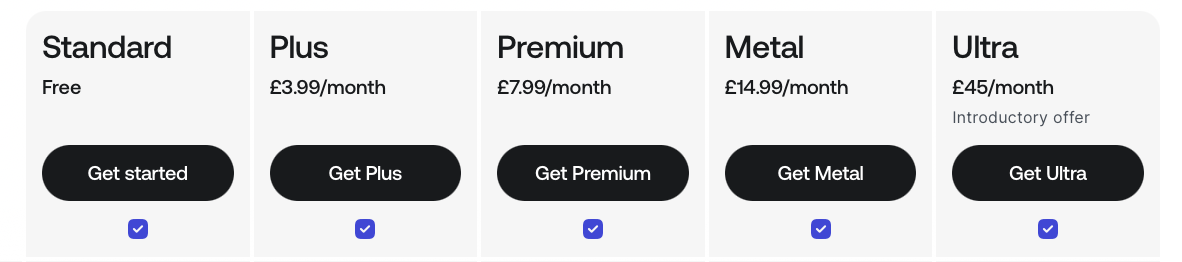
- Revolut offers 5 pricing plans. The Standard plan is a good option for free users.
- Plus and Premium plans are great for entry-level entrepreneurs. Whereas Metal and Ultra plans are geared towards travelpreneurs with lifestyle-enhancing benefits.
- Interest on savings on the free Standard plan is ~2.3%. Whereas 4% on the Metal plan and 4.75% on the Ultra plan.
- Investment opportunity on stocks and ETFs with no minimum requirement. Also, there is no commission on stock trading. Only regulatory fees.
- Savings Vaults is a cool new feature that can help you save money. You can set goals, assign deadlines, and transfer spare funds from your purchases. You can also create a Group vault with family and friends.
- Revolut makes your international travel easier. Over 25 currencies exchange, fee-free ATM withdrawals, cashback, lounge passes, insurance for trip cancellation or flight delays or damaged luggage, etc.
Revolut Bank Pros and cons
Pros:
- Metal and Ultra plans offer decent APY
- Investment opportunities in stocks and ETFs
- No minimum balance is required for investment
- Travel and shopping benefits
Cons:
- Limited ATM withdrawals with a 2% fee when exceeds the monthly limits
- No ATM card for Standard plan users
5. Wise

Once known as Transferwise, this foreign exchange fintech company does much more than cross-border transactions.
Regulated by the UK’s Financial Conduct Authority, Wise now offers a full-fledged business banking solution.
What’s special about Wise is that the transactions are based on the true mid-market rate. Something that only a handful of companies offer.
This feature is especially useful for multi-currency users where they get the optimum exchange rate. While avoiding the bank markups.
With Wise, you can send money to just about any standard bank account. And not just Wise-to-Wise transactions.
Wise Key Features
- Wise uses a mid-market exchange rate. Unlike other banks, they calculate the cost of currency exchange based on the average between buying and selling rates. While targeting the latest fluctuations.
- You can order a Wise business debit card for free once you register the account. But it costs a one-time fee of £3 for each team member.
- Wise also lets you order its Travel Money card which can help you withdraw in over 50 currencies over 160 countries. You can withdraw from any standard ATMs worldwide. However, there is a limit of £200 per month. Also, it costs you a one-time fee of £7.
- With a Wise business debit card, you can get 0.5% interest earnings. Besides a physical debit card, you can also use a digital card for shopping both online and offline.
- Easily integrates with accounting software like Xero and Quickbooks. You can add team members, set permissions, and automate workflows.
Wise Pros and cons
Pros:
- Great for multi-currency exchange
- Uses mid-market rate for currency exchange
- Ability to add team members and issue Wise debit cards
- Can process batch payments of up to 1000 accounts
Cons:
- Relatively lower limits of transfer
- A bit slower money transfer than the competitors
6. Relay

Relay is pretty much similar to newer neo-banks. But backed by a hundred-year-old Thread Bank and Evolve Bank and Trust.
Relay doesn’t try to persuade you by providing perks like cashback rewards or interest earnings. Rather, it focuses on Business banking essentials at no monthly fee.
Relay is even better if you’re a small team with a tight budget. But if you’re a growing startup, Relay Pro plan should be your go-to choice.
With a $30 subscription, you can get the most out of accounting and bookkeeping automation that the free plan lacks.
Relay Key Features
- Relay free plan is a great first place for new businesses. No fee for opening an account, minimum balance, and overdraft.
- Payments using ACH transfer, wire, and check are also available on the free plan. However, Pro plan users get the advantage of same-day ACH and free wire transfers.
- Relay’s employee expense management helps you control employee spending and expense tracking. You can issue up to 50 physical or digital Visa debit cards on both plans.
- The maximum daily transaction limit on a Relay debit card is $7000. And the ATM withdrawal limit is up to $1000.
Relay Pros and cons
Pros:
- No fees or minimum balance required
- Relay accepts cash deposits
- Feature for employee spending and tracking
- Accounting and bookkeeping features on the free plan
Cons:
- Lacks discount and interest perks
- Extra fees on domestic and international wires
7. Grasshopper

A grasshopper always jumps forward. And this online bank is creating a buzz around business checking for startups.
Although new in the fintech marketplace, businesses are in awe of Grasshopper’s range of banking services.
From startups, venture capital, private equity, and SBA lending to integrating its API into business. Grasshopper has got their back.
Not a finance-savvy?
Don’t worry! Grasshopper’s Banking-as-a-Service (BaaS) takes the front seat and lets the software do most of the heavy lifting for you. While you spend more time generating sales.
Grasshopper bank key features
- There is no monthly fee. However, you need to deposit a minimum of $100.
- With Innovator Business Checking Account, you can earn up to 2.25% APY. This applies to balance between $25,000 to $250,000. However, anything below or above the balance will get you 1.51% APY.
- Grasshopper debit card comes with a 1% cashback reward on every online or signature-based purchase. You can also issue a personalized physical card for your brand.
- Based on the reference, you can apply for a corporate card. For any purchase worth $1000 within 30 days of opening the account, you’ll receive a $500 Amazon e-gift credit. In addition, 1.5% cashback reward on online or signature-based purchases.
- Tailored support for new founders with Grasshoppers’s accelerator program. You’ll get access to in-house experts to help you raise capital and find investors.
Grasshopper pros and cons
Pros:
- No monthly fees and unlimited transactions
- Up to 2.25% APY with an unlimited 1% cash back on purchases
- Comes with free accounting and bookkeeping tools
- Unlimited free ACH and incoming domestic wire transfers
Cons:
- Requires a $100 minimum opening deposit.
- Lacks tax preparation tools
8. Bluevine
Why not put your bet on a bank that doesn’t demand a monthly fee, minimum balance, and minimum deposit?
Bluevine is that platform where you won’t be limited to the number of transactions either. Even free ACH and incoming wire transfers are some nice perks to have.
But when it comes to interest earnings, there is a quirky side to it.
Bluevine comes with 2 plans and 2 different APYs. And to claim the benefits, you have to work out a bit.
Let’s understand each of them in the features below.
Bluevine Bank key features
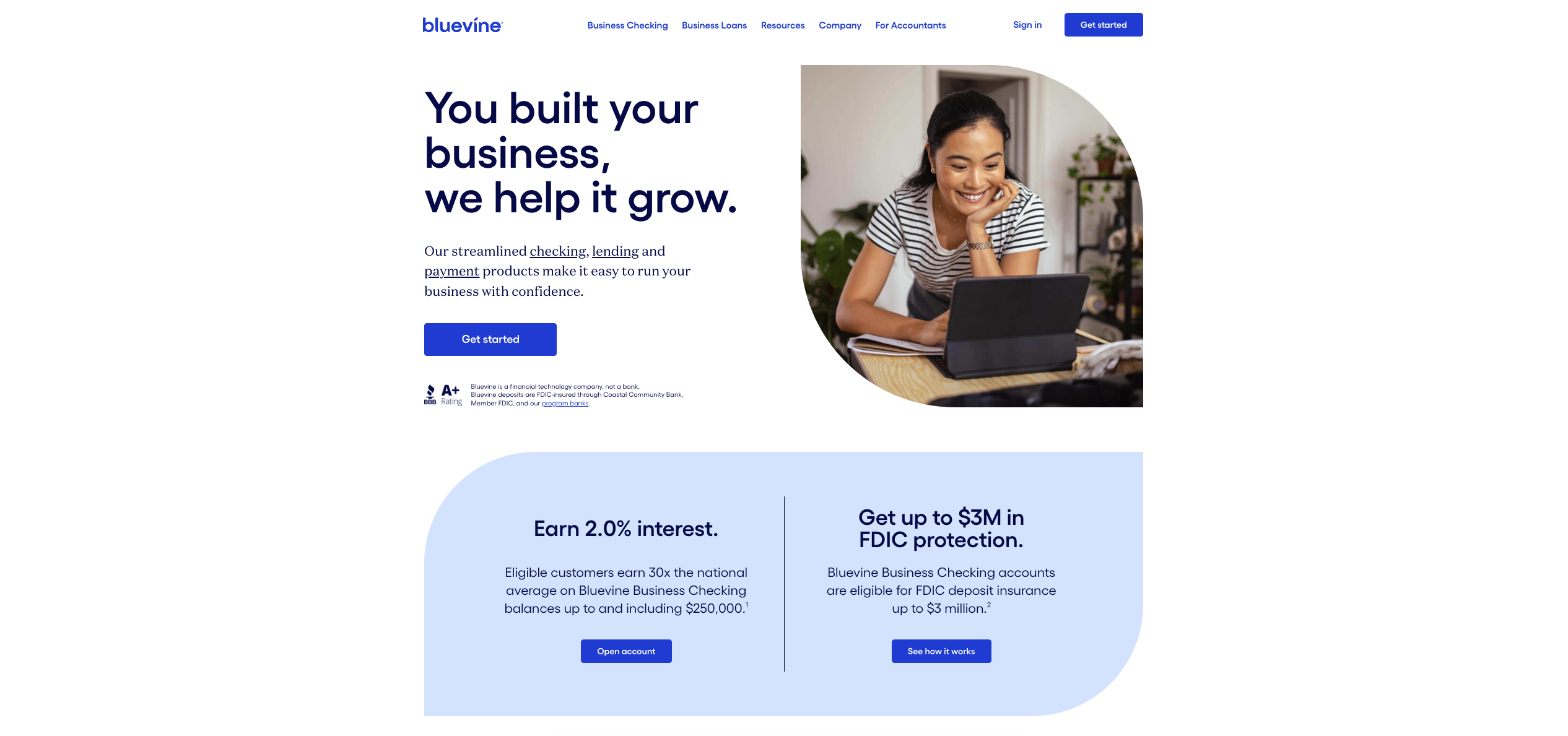
- On Bluevine’s free business checking account, you can earn 2% APY (on account balance up to $250,000). Only when you spend $500 per month using Bluevine debit card. Or receive $2500 in your checking account each month.
- The paid account or the Premier plan offers you an impressive 4.25% APY for a balance of up to $300,000. You have to pay $95/month, though.
- Premier plan also offers payment-free discounts and dedicated customer support.
- You can also earn 4.25% APY with the benefit of no monthly fee if:
Your checking account holds a minimum $100k on average
You use Bluevine debit card to make purchases up to $5000.
- Bluevine comes with free accounting and bookkeeping features to streamline automation tasks and save time. You can also set team permissions and roles like Accountant, Authorized user, and Contributor.
Bluevine Pros and cons
Pros:
- Attractive APY for startups with a decent fund
- No minimum balance or opening fee deposit
- Free bookkeeping and accounting features
- Up to $3 million insured by FDIC
Cons:
- Lacks business savings account
- Requires a decent balance to avail 4.25% APY
9. Axos

We see how neo-banks offering business checking accounts are designed to suit startup professionals.
But ever heard of the checking accounts made for people around you – both young and old?
Ever heard of these banks offering ATM fee reimbursement?
Or ever had a neo-bank card with a savings account as well?
If these are some services you’re interested in, Axos Bank is exactly the one for you.
Axos Bank key features
- You’ll have 5 checking account options for both professional and personal use cases:
Essential Checking
Rewards Checking
CashBack Checking
Golden Checking
First Checking
- In Essential checking account, there is no fee or any minimum deposit. There is no interest either. But it comes with an early direct deposit feature.
- In Rewards checking account, you can earn up to 3.30 APY. However, there is a list of criteria you must meet. One of them is a minimum $50 deposit.
- Cashback checking account lets you earn a 1% cashback reward on monthly purchases of a maximum $2,000. However, you need to hold a daily balance of a minimum $1,500.
- Golden checking account is made for seniors. Whereas the First checking account is meant for teens. Both accounts are fee-free, have 0.10% APY, and provide secure banking features.
- Axos Bank provides unlimited fee reimbursements on all domestic ATMs – for both checking and savings accounts.
- Also comes with a Personal Finance Manager dashboard. A unique feature to track multiple accounts, investments, expenditures, and savings – all in one place.
Axos Bank pros and cons
Pros:
- Comes with both business checking and savings accounts
- Fee-free checking accounts
- Unlimited domestic ATM fee reimbursements on all accounts
- Investment option with no-commission trading
Cons:
- Low APYs on CDs and savings accounts
- Requires a list of criteria to meet 3.30% APY
10. Chime

Some banks offer strong APY. But at the expense of a monthly subscription or a long list of financial criteria.
And then there are a few banks like Chime that don’t ask for a monthly fee. Doesn’t require you to have a minimum deposit. And even spares you from international transaction limits. Chime, however, may not have a decent APY rate or cashback offer. But it doesn’t disappoint you with the combo of business checking and savings accounts. On top of it, Chime offers some interesting perks that are hard to overlook.
Chime Bank key features
- Chime comes with the advantage of managing checking accounts and savings accounts within a single app.
- You can also transfer unlimited funds from savings to a checking account – quite an uncommon feature in an online bank.
- Features early direct deposit where you’ll receive funds in your checking account two days earlier.
- It lets you automate a 10% deposit of the funds to your savings account every month.
- With Chime savings account, you’ll receive an annual yield of 2%. Also, there is a daily limit spending of $2,500.
- Chime limits you with up to $500/day ATM withdrawals and a monthly transaction limit of up to $2,000.
- You can also issue Chime’s Visa credit card. However, you must receive a minimum direct deposit of $200 each month to qualify for the card.
Chime Bank pros and
Pros:
- Features both checking and savings accounts
- No monthly fee or monthly deposit
- Comes with an automated savings feature
- Ability to transfer unlimited funds from savings to checking account
Cons:
- Limited ATM withdrawal and transaction amount
- Chime mobile app unavailable in some regions
11. SoFi

We often come across online banks offering both checking and savings accounts. But ever heard about any of them offering APYs for both accounts?
Well, if you’re putting a bet on anything like this, you can’t go wrong with SoFi.
But what makes SoFi even more interesting is its community.
So when you become a member, SoFi rewards you with not one but several benefits.
For example, cashback at selected retailers, referral bonuses, free financial help, community rewards, and many more.
After all, SoFi stands for social finance.
SoFi Bank key features
- SoFi’s fee-free checking account lets you earn 0.50% APY.
- SoFi’s savings account also lets you earn APY. But an impressive rate of up to 4.60%. However, you must hold a minimum amount of $5000 every month to qualify.
- With SoFi’s debit card, you can earn cashback of up to 15% across selected retailers.
- With Vault feature, you can create up to 20 vaults. A kind of sub-account within the savings account. Here you can save money for specific goals and keep separate accountability.
- You can even set automated transfers to each of these vaults directly from your checking account.
- Roundups feature saves your money by rounding up each of your purchases to the next whole dollar. You can then set up an automated transfer to your choice of Vault.
SoFi Bank pros and cons
Pros:
- No minimum balance or monthly fee
- Interest earnings on both checking and savings accounts
- SoFi membership offers extra perks
- Also offers financial services like insurance, loans, investment, refinancing, and credit card
Cons:
- SoFi app is not accessible in some regions
- Requires a larger balance to qualify for a higher APY rate
12. Oxygen

Startups are volatile especially when they start to scale. They don’t often stay with any services for long. And so they do with the banking.
This is where Oxygen Bank sets itself apart.
This fintech startup comes with 4 tiers. No matter whether you’re on the free plan, you’re going to receive decent perks.
And while your business scales, their progressive tiers might encourage you to be a long-term user.
On top of it, you’ll get both a checking and savings account.
Oxygen Bank key features

- Oxygen offers 4 plans: Earth, Water, Air, and Fire. There is no fee or minimum deposit for Earth users.
- Cashback rewards are available on all the plans:
2% on Earth
3% on Water
4% on Air
6% on Fire
Note that, Earth users must spend a minimum of $350/ month to avail of the cashback benefits.
- Oxygen stands out from the crowd with its loyalty rewards program called Ambassador Reward.
Earth plan: 25% discount on annual fee when you spend $4,200
Water plan: 25% + $25 discount when you spend $12,000
Air plan: 25% + $50 discount when you spend $18,000
Fire plan: Extra $150 discount on top of Air plan when you spend $25,000
- With Oxygen virtual cards, you can set spending limits for employees as well as family members.
- Earth and Water users can issue up to 3 and 10 virtual cards respectively. Whereas, unlimited virtual cards for Air and Fire users.
- Oxygen Friends is a useful feature to help you split bills, plan a trip, collaborate on projects, or manage rent expenses.
Oxygen Bank Pros and Cons
Pros:
- Free business account available
- Unlimited number of free transactions
- Cashback rewards and APY on all the plans
- Retail and travel benefits
Cons:
- High spending criteria for paid tiers
- Free plan requires a minimum of $350/ month in expenses for cashback benefit
Final words
Banks with benefits. Certainly, they are.
The entire process of neo-banks is blazing fast. Makes traditional banking feel sluggish. They end up with a walking stick, slowly passing by while grinning to get past the embarrassment.
Neo-banking changes the way you could manage your money. While sparing you from scratching your head and wasting time.
Although traditional banks are too technologically far behind to catch up with them. Startups are still banking on the trust that they built up over decades.
And that is what neo-banks are trying to develop in this digitally-driven marketplace.
However, we won’t recommend neo-bank if this is going to be your first-ever bank.
Rather, it complements well with your traditional bank account. Giving you a whole new level of banking experience altogether.


 A better way to manage projects and clients for freelancers
 Get through busy days like a breeze with Reclaim.ai