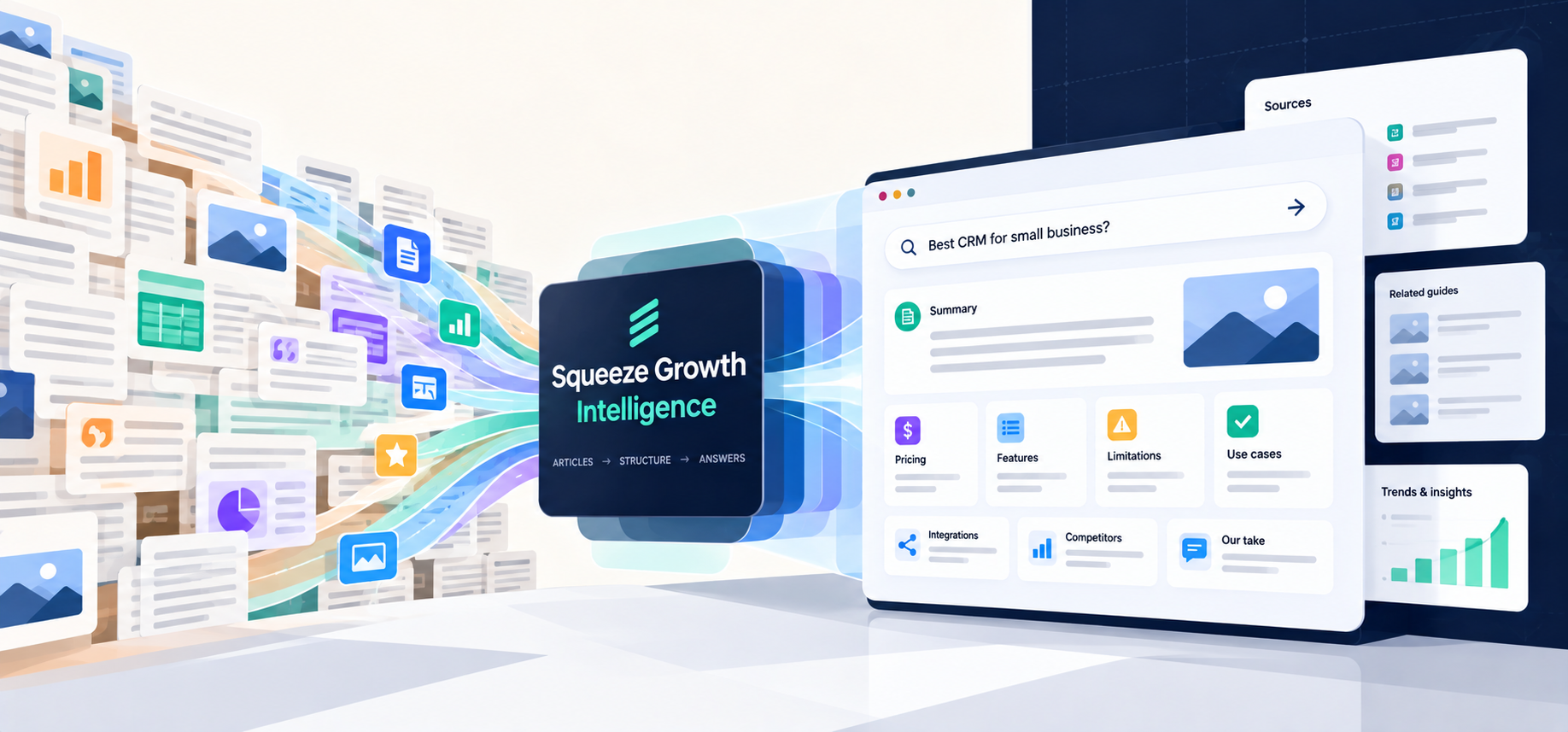
I’ve always looked at Squeeze Growth as more than a place where we publish software reviews and marketing articles.
The original idea was simple: help entrepreneurs and businesses make better decisions. Sometimes that meant finding a better CRM, sometimes understanding a marketing strategy, and sometimes learning from someone who had already built what you were trying to build.
Over the years, we’ve accumulated a ridiculous amount of research doing that. We’ve tested software, compared products, looked at pricing, written guides, taken screenshots, talked to companies and covered everything from email marketing platforms to project management tools.
Today, we’re starting to do something new with all of it.
We launched Squeeze Growth Intelligence.
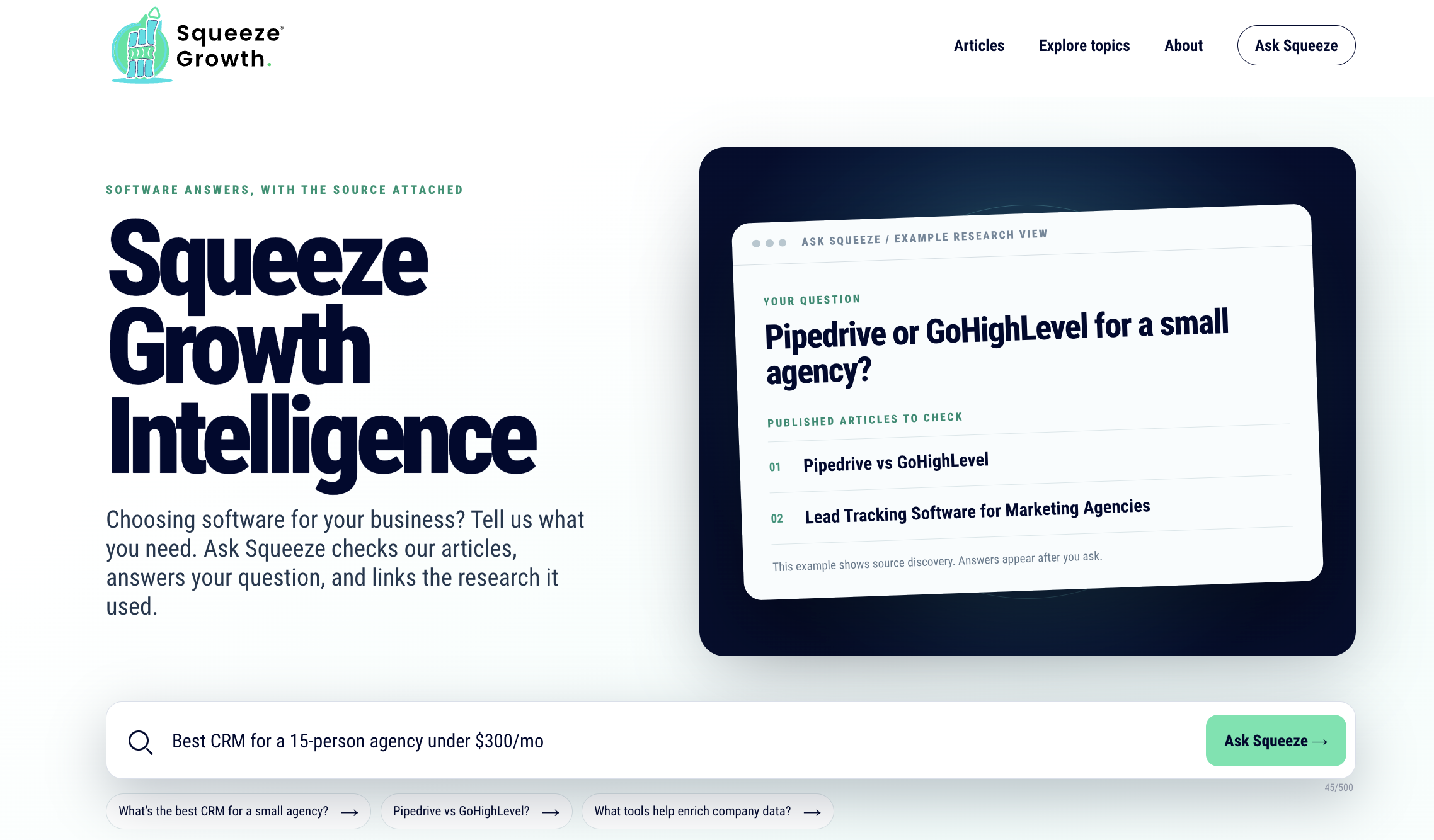
And the first thing we’ve built is Ask Squeeze.
You can now come to Squeeze Growth, describe what you’re trying to do and ask a question. Ask Squeeze goes through our published articles, finds the research relevant to your question, generates an answer from those passages and shows you the articles it used.
I’ve wanted Squeeze Growth to work like this for a while.
Because once you have thousands of pieces of information sitting across a website, the next challenge isn’t always producing more information. It’s making all of that information useful in ways that weren’t possible before.
We Have Been Organizing Information Around Articles
Think about how you normally research software.
Let’s say you run a small marketing agency and you’re considering Pipedrive and GoHighLevel. You’ll probably search for a comparison, read a few reviews, open the pricing pages, check Reddit and then start looking for answers to the questions that actually matter to your business.
The problem is, those questions can get incredibly specific.
Maybe you don’t care which product has more features. You want to know which one would be easier for five people to use when all you need is a clean sales pipeline and basic follow-ups.
That’s not really a “Pipedrive vs GoHighLevel” question anymore.
It’s your question.
Traditionally, we would try to anticipate it while writing the article. We’d cover the features, pricing, advantages, disadvantages, ideal users and as many useful scenarios as reasonably possible.
But there is an obvious limitation to that model. An article has to be written in one order. Your questions don’t arrive in one order.
That’s what started making AI particularly interesting to me.
What I Find Interesting About AI
I use AI a lot myself.
One thing it has completely changed for me is how I ask for information. I don’t have to convert whatever is in my head into a neat little search query anymore.
I can explain the situation exactly as it is.
I can say I run this type of business, already use these tools, have this particular problem, don’t care about these features and absolutely need this other feature.
That’s much closer to how we actually make decisions.
And I started thinking: why shouldn’t Squeeze Growth work the same way?
We already have the research. Why should someone have to understand the structure of our website before they can use it?
If we’ve already researched something relevant to you, you should be able to ask for it.
That’s essentially what Ask Squeeze does.
How Ask Squeeze Works
There isn’t any mystery behind it.
You ask a question and we look for relevant passages inside published Squeeze Growth articles. Those passages, along with your question, are sent to the AI so it can put together an answer based on the material we’ve actually published. The original articles are shown alongside the answer so you can inspect them yourself.
The basic flow looks like this:
Ask a question → Find relevant Squeeze Growth research → Generate the answer → Show the sources → You make the call
That final part is important.
I’m not particularly interested in building another chatbot that gives you an answer and expects you to trust it because the text sounds convincing.
There are already plenty of amazing general-purpose AI products for that.
What interests me is combining AI with a body of work we actually control and continue improving.
If Ask Squeeze says something about a product based on one of our articles, you can open the article and see where it came from. If our existing research isn’t good enough to support the answer, the system is designed to tell you that rather than confidently fill in the blanks.
That’s a much more interesting relationship between a publication and AI, at least to me.
The Research Becomes More Valuable, Not Less
There’s a strange assumption around AI and publishing that eventually AI should just write everything.
I think that’s looking at it backwards.
Writing text is now extremely easy. Give any good model a topic and you can have a reasonably structured article in seconds.
But if everyone can generate the words, the work behind the words becomes more important.
Did someone actually use the software? Did they compare it with the alternative? Did they notice what happens after the free trial? Did they understand the pricing properly? Did they find the limitation hidden three menus deep? Did they have enough experience to explain which type of business shouldn’t use it?
That’s the stuff I care about.
For Squeeze Growth, I don’t see AI as a reason to stop investing in that work. I see it as a reason to make the work much better.
Because now one detailed piece of research doesn’t have to answer one predetermined search query. It can help answer hundreds of different questions.
An Article Can Become a Knowledge Source
This is probably the shift I’m most excited about.
Suppose we spend days researching a product and publish a 5,000-word review.
Traditionally, the review is the final product. Someone finds it, reads whatever portion interests them and hopefully gets what they came for.
With Squeeze Growth Intelligence, I look at that same review differently.
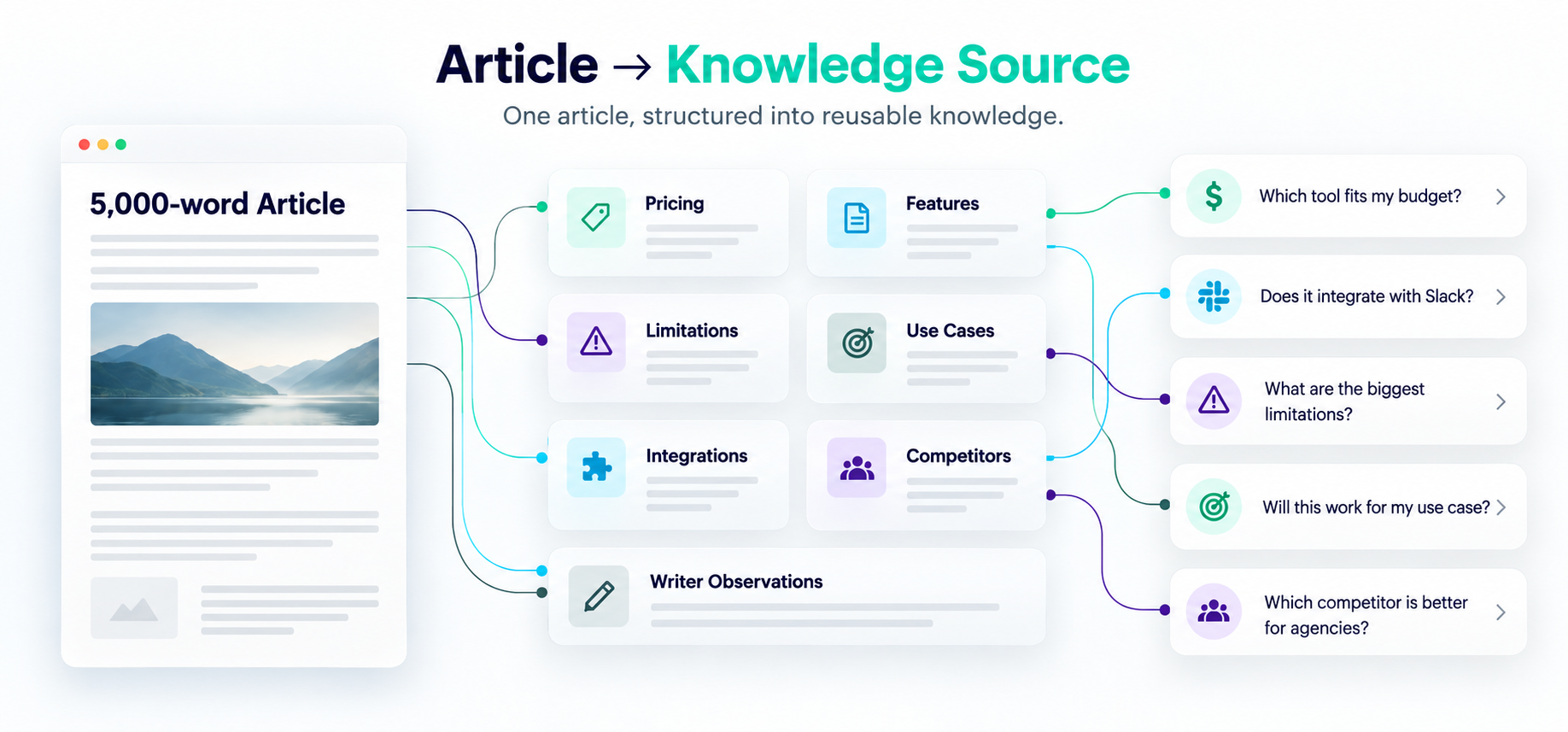
It is still an article people can sit down and read. But it is also a collection of information about pricing, features, use cases, limitations, workflows, competitors and the writer’s experience.
Now imagine connecting that information with hundreds of other articles we’ve published.
The individual webpage stops being the only way you can access what we know.
You can start asking questions across the library.
That’s where this gets much bigger than putting a chat box on a website.
Software Recommendations Need Context
I’ve written and commissioned enough “best software” content over the years to know that the word best causes problems.
What’s the best CRM?
I don’t know. Tell me who you are first.
A five-person agency and a 500-person sales organization can both search for “best CRM” while needing completely different products.
One business may care almost entirely about automation. Another wants something employees can understand without sitting through three days of onboarding. Someone might happily pay $1,000 every month if a tool replaces three other systems, while another company needs to keep its entire software stack below that amount.
Yet software discovery still forces everyone through roughly the same pages.
I think we can make that experience far more intelligent.
Eventually, instead of starting with a category page, you might start by telling Squeeze Growth about your business.
For example:
I run a 12-person content agency. We use Notion and Slack, but project visibility is becoming difficult. Clients need limited access, I don’t want enterprise software, and I’d like to keep everything below $200 per month.
Now we have something useful to work with.
Instead of showing you 15 project management platforms and leaving you to figure it out, Intelligence can start narrowing the market according to the things that actually matter to you.
Which products fit? Which ones can immediately be ruled out? Where are the tradeoffs? What are you likely to pay? What have we found while researching them?
And most importantly, what evidence are those answers based on?
That’s much closer to how I think software research should work.
Building an Intelligence Layer for Squeeze Growth
Ask Squeeze is the first version, not the finished vision.
Right now, I’m deliberately keeping it simple. Ask something, let the system find our research, read the answer and open the sources if you want to go deeper.
But once you start thinking about Squeeze Growth as an intelligence layer rather than only a collection of webpages, there are a lot of things we can build.
A product could have structured intelligence around who it is actually good for, what it integrates with, how its pricing changes as a company grows, what users should know before switching to it and how it compares under very specific circumstances.
Software categories could become interactive instead of static. Comparisons could change according to what the person making the comparison actually cares about. And recommendations could become much more specific than putting ten tools in an article and arranging them from one to ten.
I don’t want to build all of that at once.
But that’s the direction.
There Is Another Side to the Equation
While working on this, I also started thinking about the software companies themselves.
We’ve spent years sitting between software companies and people evaluating software. That gives us a useful view of both sides.
A buyer wants to understand which product makes sense. The company building the product wants to understand why that buyer chose them, or didn’t.
AI is making that second side particularly interesting.
Think about the questions software companies are going to start asking as more purchasing decisions are influenced by AI systems.
When does our product get recommended? Why are we being compared with this competitor? Which use cases are strongly associated with us? What information about our product is unclear? Which objections repeatedly appear when someone evaluates us?
There’s a huge intelligence problem forming there.
And it is closely related to the problem we’ve already spent years working on.
The buyer is trying to understand the software company. The software company is trying to understand the buyer.
Squeeze Growth sits in the middle.
I think that’s an interesting place to build from.
The Questions Themselves Become Valuable
There’s another thing Ask Squeeze gives us that I’m particularly excited about.
Questions.
For years, a major part of publishing has involved trying to understand what people want to know before they tell you.
We look at search queries, keyword volumes, competitor pages, trends and dozens of other signals.
Now someone can simply ask.
Suppose a lot of people evaluating a particular CRM keep asking whether it works with a certain type of business.
And suppose our research doesn’t answer that well enough.
That’s useful.
It tells us exactly what we should go and investigate.
Maybe we need to update the review. Maybe we need to test a workflow we ignored. Maybe there is an entire comparison nobody on the team thought was important.
The reader’s question can improve the research, and the improved research can then improve future answers.
Better questions → better research → better answers.
That’s a loop I’m very interested in building.
Where I Want to Take Squeeze Growth
When I started Squeeze Growth, the website itself was the product.
We published useful information and people came to read it.
I still believe in that. The articles aren’t going anywhere, and I want the quality of our original research to become significantly better over the next few years.
But I now think the information can do much more.
It can be queried. It can become contextual. It can connect information that currently lives in completely different articles. It can help someone narrow a market according to their actual requirements rather than a generic ranking.
Eventually, it can also help software businesses understand how they’re being evaluated.
That is what Squeeze Growth Intelligence means to me.
Not putting AI everywhere because AI is popular.
Taking everything we’ve learned and published over the years, and building a new layer on top of it that wasn’t realistically possible before.
Try Ask Squeeze
Ask Squeeze is live on the Squeeze Growth homepage now.
If you want to test it, don’t make the question easy.
Tell it what you’re actually trying to accomplish. Give it the products you’re considering, explain your business, mention the features you care about and tell it what you don’t want.
Then look at the articles behind the answer.
There is a lot more I want to build, and the version you see today is only the foundation.
For years, we’ve been building Squeeze Growth’s research library.
Now we’re building a way to think with it.
P.S. We are actively building it, so if you find a bug or want was to put something on the roadmap, hit me at aayush @ squeeze growth .com


 A better way to manage projects and clients for freelancers
 Get through busy days like a breeze with Reclaim.ai