Back in 2025, Alex Hormozi broke the Guinness World Record for the fastest-selling non-fiction book with “$100 Million Money Models”.
In fact, he beat the previous record in the first 90 minutes of launch.
But that’s the least interesting thing about him.
While almost 90% of startups fail, Alex Hormozi has had a crazy winning streak.
His success spans across advisory, gyms, consulting, courses, e-commerce, SaaS, private equity, real estate and more!
That’s not luck.
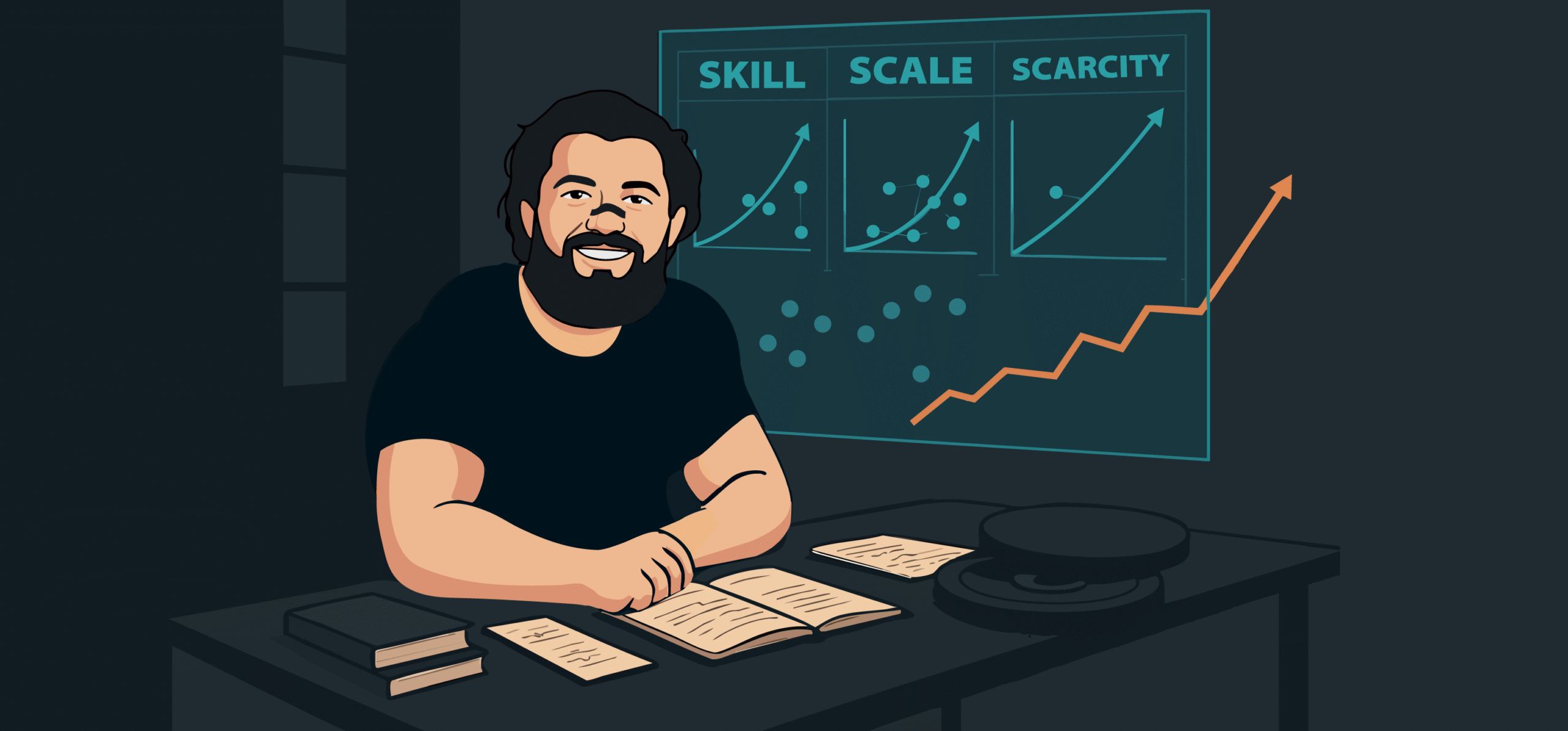
Alex Hormozi’s business framework comes down to three things he has built and refined across every venture:
Skill, Scale, and Scarcity.
Let’s uncover how it helped him become an outlier among start-up founders.
Identifying the right skills

Everything you build starts with skill.
The specifics differ, but a few constants show up regardless of what you’re building.
Skills Every Business Needs
If you can’t sell, you can’t build a business.
No matter what you’re building, three things will always matter most.
Offer, sales, delivery; everything else is secondary.
1. Creating an irresistible offer
Start with your audience, not your product.
You need to understand what your target customers want, what’s stopping them from getting it, and how you can solve both.
Here’s how to build that offer:
Step 1: Find their dream outcome.
Step 2: Identify the obstacles standing between them and that outcome.
Here are the most common obstacles that exist regardless of the product or service:
- Is it worth it?
- Is it easy enough?
- Is it fast enough?
- Do they believe they can actually do it?
Step 3: Build a path to that dream outcome while removing each obstacle.
The goal is to create offers so good people feel stupid saying no.
Want to go deeper on this? Check out this free course where Alex breaks down the grand slam offer framework in detail.
2. Sales is just communication
Let’s ignore the technical aspects of sales for moment.
Cold outreach, warm outreach, organic content, paid ads; every tactic comes down to one question.
Can you clearly communicate what you do, who you help, how you help them, what result they get, and why you’re a better option than your competitors, while making it sound compelling?
The better you answer that, the more clients/customers you get. It even applies to hiring great talent and building a strong network.
You can always find experts claiming almost every channel is dead.
Every niche Alex entered looked saturated.
But he still made it work, because he made his offers feel irresistible and communicated it better than anyone else in the space.
3. Delivery comes down to pattern recognition
Most businesses have the same problems. Most services solve the same pain. Most results come from the same core actions.
There’s a pattern to everything. The better you spot it, the better your systems get.
That’s what makes consistent delivery possible.
With Gym Launch, Alex took the exact growth and retention strategies he used to turn around struggling gyms and packaged them into repeatable systems. Same problems, same solutions, delivered consistently at scale.
Without recognising the patterns, none of that would have been possible.
Stacking Skills to Multiply Your Value
Skills stack on top of each other and create asymmetrical returns to all of the skills before them.
Alex talks a lot about skill stacking. He’s also a living example of it.
The idea is simple. Build related skills on top of each other, and you become significantly more valuable. Alex frames it as “many skills, 1+1=5.”
Here’s how Alex did it:
He has a B.Sc in Human and Organisational Development with a focus on Corporate Strategy, plus two years of working experience as a management consultant for a strategy firm.
He knew how to run a business. He also had a passion for fitness since he was 15.
So he quit his job, combined both, and launched six gyms across different locations over two years.
Running them, and turning some of them around from near failure, taught him exactly what it takes to make a gym profitable.
He took those skills and started helping other gym owners do the same. That sharpened his systems further and built real credibility.
It eventually led to Gym Launch, a coaching and licensing model that helped gym owners increase profitability, acquire more clients, and improve retention.
His education, consulting experience, personal business track record, and proof of growing other businesses all stacked into one thing; Acquisition.com, built to help businesses across industries scale.
Each skill built on the last.
That’s how 1+1=5 works in practice.
The Linear Path to Scaling

70% of startups fail directly due to premature scaling.
But, Alex has successfully scaled a portfolio of businesses to over $250 million in annual revenue.
Two patterns show up consistently across everything he scaled.
More, Better, New
Most businesses try to do everything at once.
But, changing multiple things at once means you’ll never know what actually moved the needle.
So, Alex took a linear approach.
More, Better, New
More
If your current offer makes money, what happens when you deliver ten times as much of it?
That’s exactly what Alex asked himself after his first gym turned profitable.
If one gym works, what stops you from opening five more?
Don’t change the product. Don’t tweak the pricing. Just increase the volume.
Push the same thing harder until you hit your absolute maximum capacity. That’s when you know you’re ready for the next step.
Better
Once you hit that ceiling, stop pushing for volume and start optimising.
Real scale means building repeatable systems so the business grows without the founder being the primary bottleneck.
This is where you tighten operations, plug the leaks, expand your team, and improve your margins.
Better means making more money for the same amount of effort.
Do it systematically. Fix the biggest operational bottleneck first, the one with the highest impact, then move to the next.
New
Once you’ve squeezed every drop of efficiency out of your operations, you can move into something new.
But the biggest mistake you can make is jumping into an unrelated business and starting from zero.
There are two smarter ways to expand:
1. Offer something new to your existing customers.
After successfully running Gym Launch, Alex started selling supplements through Prestige Labs directly to the gym members of his existing clients. Same set of end users, but a new offer.
2. Take your existing offer to a new market.
After selling courses and consulting to gym owners, Alex built similar services for business owners across other industries. Same model, new market.
The goal is to change as little as possible to extract as much value as possible.
That’s how you scale without starting from zero every time.
Customer Value Optimisation
The business that provides the most value wins.
Most businesses focus entirely on the first sale. So they’re always hunting for new buyers. But Alex took the opposite approach.
Instead of chasing new customers, he found ways to deliver more value to the ones he already had.
More value delivered means more revenue from the same customer.
His gym business is the clearest example.
A gym membership gives people a chance to get fit. Personal training, nutrition guidance, and challenges gives them curated routines and meal plans to get the exact results they expect. Finally, Prestige Labs gives them premium supplements to speed up their results.
Acquisition.com runs on the exact same logic.
Free YouTube content teaches business owners how to grow. It builds trust and earns ad revenue at the same time. That content drives people to free courses and roadmaps on AQ.com.
From there, workshops give business owners making over $250k in revenue a chance to go deeper, with structured teaching and personalised inputs from Alex and his team. These run around $5,000 and capture buyers who are ready for serious help.
Once your business crosses $1M-$10M EBITDA, you get access to his private equity arm. He invests for equity, helps you scale, and exits after five years.
Each stage solves the next problem the customer has. That’s the compounding power of CVO.
You don’t monetise an audience once. You keep solving their next problem as they grow, and your returns scale with them.
Want to learn the art of scaling a business from Alex Hormozi? Here.
Using Scarcity to Sell Faster and Charge More
Fear of loss is stronger than desire for gain.
When something feels limited, the brain stops asking “should I buy this?” and starts asking “what if I miss out?”
That shift drives faster decisions and higher perceived value. Both of which justify premium pricing and help you sell more.
There are two ways to create scarcity and urgency:
1. Limit the quantity available
2. Limit the time someone has to buy
The goal is simple. Move a customer from “maybe later” to “if not now, never.”
Here are a few ways Alex teaches you to do that:
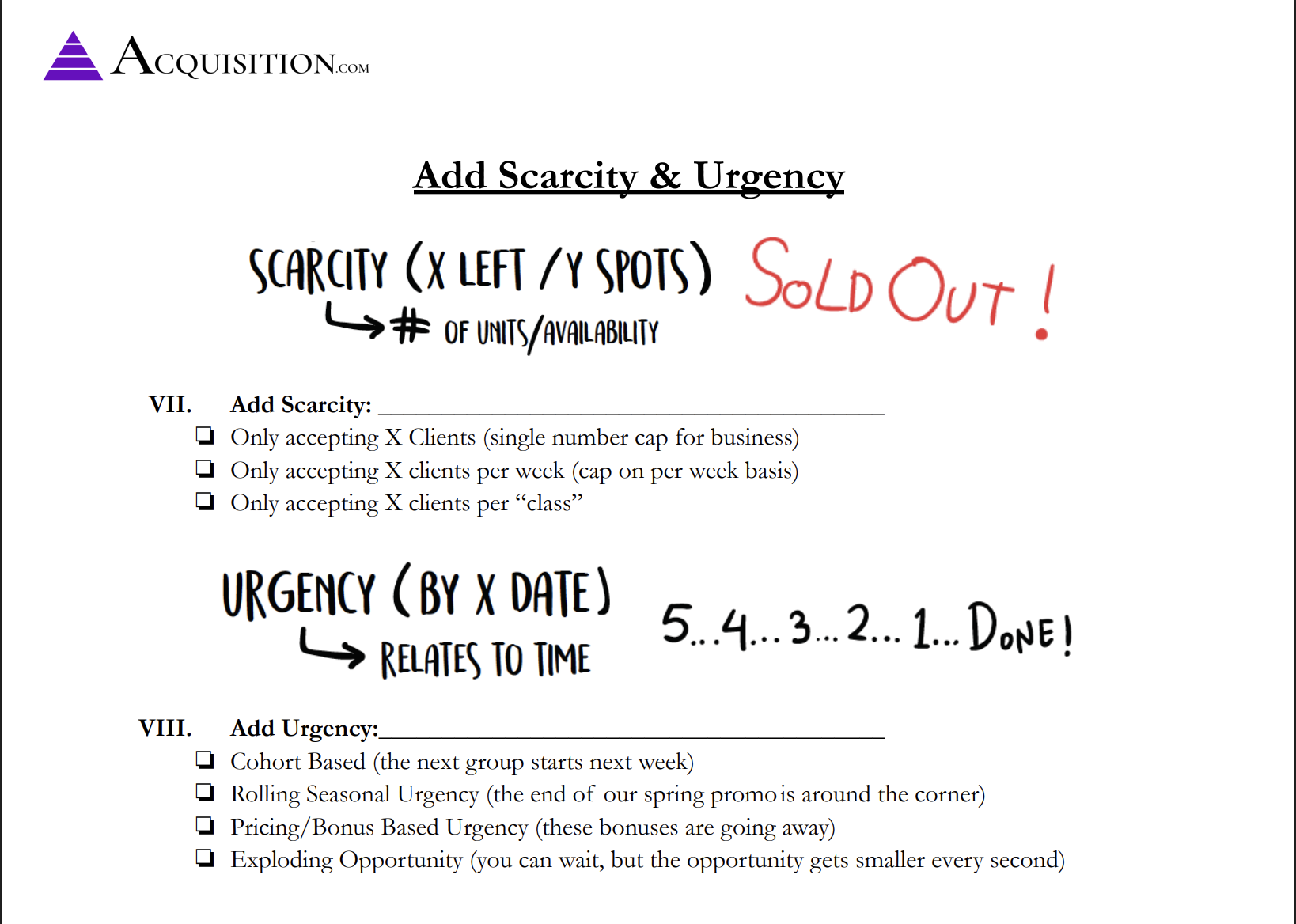
Here’s something even more interesting:
Alex intentionally sells fewer spots than he could fill.
Selling out fast creates proof of demand. Every subsequent launch sells out faster because of that track record, which pushes perceived value higher. It’s also a big part of why he’s been able to charge premium prices across everything he’s sold.
But scarcity only works when it’s real.
Fake countdown timers and “almost sold out” claims destroy your credibility. Your audience sees through it, and once they do, you lose their trust for good.
The good news is you don’t need to fake it.
There’s almost always a real operational limit. You can’t take on 1,000 clients. You can’t give every customer a discount. You can’t invest in every business you come across. Use those natural limits to create genuine scarcity.
That’s exactly what Alex did with Gym Launch.
He only worked with one gym per zip code.
And he told gym owners straight up that if they passed, he’d call the competitor down the street and offer it to them instead.
That wasn’t a sales tactic. It was true. Helping two gyms in the same area would mean competing against himself. He couldn’t have delivered results for both.
How well did it perform? Gym Launch generated around $3 million in net profit in its first year and eventually scaled to 6,000+ gyms across 22 countries.
Want to learn how to use scarcity the right way? Check this out.
Final Thoughts
Most people wait until they feel ready.
They keep learning, planning, and preparing. But Hormozi’s entire framework is built on the opposite idea. You get ready by executing, stacking, and iterating.
Now, you already have a foundation. The question is whether you’re doing the right things and doing them enough.
That’s it.
It’s time to do some serious brain storming and put these lessons into action.
All the best!


 A better way to manage projects and clients for freelancers
 Get through busy days like a breeze with Reclaim.ai